Pamphlet for a New
Energy Policy
"The
formulation of a problem is often
more essential than its solution,
which
may be merely a matter of
mathematical or experimental
skill."
Albert Einstein
5) The paradigm of the
relative ether
We
can call the current,
prevailing paradigm the
paradigm of relativism, which
is based on Einstein’s early
statements when he declared
the assumption of the
existence of the ether to be
“unnecessary.” The relativity
of morality and matter is not
wrong in itself - on the
contrary
, but the “-ism” of it is
wrong if we use it to claim
that nothing absolute exists
anymore. That was never
Einstein’s intention, and he
was also annoyed by this
interpretation. Of course,
just as you in religion have
the Holy Trinity of the
Father, the Son, and the Holy
Spirit as a given
absolute, one also has
time, space, and matter as an
absolute triad, without which
one cannot live or reason, not even
in heaven. The fact that time
must be viewed as relative,
i.e., must be considered
relative to a frame of
reference - such as the
position relative to a center
of gravity -, does not
alter this in any way. Time remains,
unchanged, the absolute
principle of life in the
created universe.
 The relative and the absolute
form a fundamental duality
that cannot simply be split in
two by declaring one half to
be non-existent. Relativism is
therefore wrong, and
absolutism is just as much so.
Einstein himself preferred to
speak of a theory of
invariants; as for him,
it was about the
absoluteness of the speed of
light. To him, it meant a
mathematical exercise; the
axiom of a constant speed of
light constitutes the basis of
his calculations. The
question, regarding the
inevitable duality of relative
versus absolute truths, is
rather: 'How do we escape
the onesidedness that seeks
to strangle fundamental
dualities?' Denying the
old ether as an absolute
entity in favor of a relative,
modern ether in the form of
the fourth dimension of spacetime
relative to the three known
dimensions, is a mistake.
The relativity of the ether in
the manifested world (curved
spacetime) does not preclude
the absolute reality of the
primordial state that
underlies that relativity. The
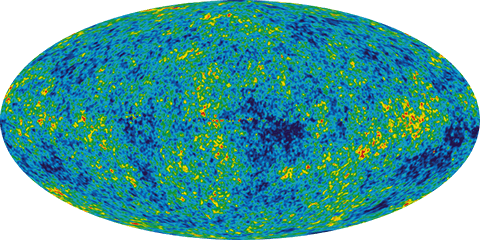
absolute nature of the ether
existed before it broke
its symmetry and led to
manifestation. It is still
measurable as the cosmic
background radiation present
in the resulting universe as
an expression of an eternal,
spacetime expansion that
transcends everything else. In
other words, the absolute
always exists alongside the
relative. In religious terms:
God exists alongside that
which He brought forth, for
parts always belong to a
whole. All that exists is part
of its Great Collection.
Alongside the relative nature
of creation, there is also the
absolute of what is physically
called the singularity,
from which everything
originated and to which
everything returns. You cannot
simply cancel one out against
the other. If we want to move
forward with our
fourth-generation free energy
technology, we must address
the ignorance surrounding the
dualities concerning the
concept of energy. So first
and foremost, the question is:
what exactly is energy?
5.1 The Definition of Energy
The relative and the absolute
form a fundamental duality
that cannot simply be split in
two by declaring one half to
be non-existent. Relativism is
therefore wrong, and
absolutism is just as much so.
Einstein himself preferred to
speak of a theory of
invariants; as for him,
it was about the
absoluteness of the speed of
light. To him, it meant a
mathematical exercise; the
axiom of a constant speed of
light constitutes the basis of
his calculations. The
question, regarding the
inevitable duality of relative
versus absolute truths, is
rather: 'How do we escape
the onesidedness that seeks
to strangle fundamental
dualities?' Denying the
old ether as an absolute
entity in favor of a relative,
modern ether in the form of
the fourth dimension of spacetime
relative to the three known
dimensions, is a mistake.
The relativity of the ether in
the manifested world (curved
spacetime) does not preclude
the absolute reality of the
primordial state that
underlies that relativity. The
absolute nature of the ether
existed before it broke
its symmetry and led to
manifestation. It is still
measurable as the cosmic
background radiation present
in the resulting universe as
an expression of an eternal,
spacetime expansion that
transcends everything else. In
other words, the absolute
always exists alongside the
relative. In religious terms:
God exists alongside that
which He brought forth, for
parts always belong to a
whole. All that exists is part
of its Great Collection.
Alongside the relative nature
of creation, there is also the
absolute of what is physically
called the singularity,
from which everything
originated and to which
everything returns. You cannot
simply cancel one out against
the other. If we want to move
forward with our
fourth-generation free energy
technology, we must address
the ignorance surrounding the
dualities concerning the
concept of energy. So first
and foremost, the question is:
what exactly is energy?
5.1 The Definition of Energy
If
we don’t know what energy is
based on the equations E=mv²
(Leibniz) or E=mc² (Einstein),
then we have a crisis, just as
you have an identity crisis if
you don’t know what your
identity is, or an economic
crisis if you no longer know
what money actually is
(namely, a dependent variable
that we manipulate; it is a
means and not an end). As is
known in physics, energy can
be recognized in the capacity
for work, which can be
expressed as the velocity of
mass (in the sense of its
angular momentum) up to the
one of the speed of light. But
does that description actually
define what energy is? If the
queen is described as a lady
with a crown in a golden
carriage, is that the
definition of a queen? We know
that in the 20th century Mrs.
van Buren, Beatrix of Orange,
was the queen of The
Netherlands even when
she was not sitting in her
golden carriage or wore a
crown. Linguistically, this
boils down to the question:
what is the difference between
a definition and a
description? Does physics
consciously distinguish
between a definition of
something and a description of
something? If not, is that
lack of distinction then
perhaps the reason we have an
energy crisis, the
crisis which, as for this,
prompted us to write this
piece on the energy issue and
the order of time? The
dictionary states:
Definition:
"A concise
description of the
characteristics of a
concept, so that it cannot
be confused with another."
Specification:
"Further description or
explanation."
Description:
"A complete list of the
details and
characteristics of
something or someone."
A description
may be complete, but it may
not be exclusive, as a
definition requires. For
example, a description of what
energy is can be confused with
a description of what a force
is. After all, force is only
energy when you apply that
force. If physics doesn’t take
this distinction too strictly,
Einstein tells us with his
formula: the force of light
consists of the fact
that its particle, the
photon, travels at the speed
of light while it (in itself
constituting a wave) moving up
and down (or else transversely
moving around) travels at that
the speed of light (and thus
constitutes the square of C).
That does sound
understandable, and it’s
interesting too, isn’t it? We
have now given Einstein’s
description the character of
an explanation by assuming
that energy and force are
concepts that are easily
confused. The dictionary
again:
Energy
in relation to people:
the force with which one
does something or strives
for something.
Electrical energy:
work performed by an
electrical energy source;
the power of electricity.
Kinetic energy:
energy associated with the
motion of an object.
Potential energy:
energy possessed by an
object as a result of its
position (e.g.,
gravitational energy), shape
(e.g., a stretched spring),
or state (e.g., a battery
containing electrical
energy).
These
definitions show us that when
energy is confused with the
force used to perform an
action, it refers to the
person. In other contexts, the
term energy refers to the work
performed with it or it refers
to itself. Definitions that
refer to themselves do not
make things much clearer. From
this perspective, what, for
example, is the energy of
light? Is that energy
electrical, kinetic, or
potential? Can we deduce that
it is kinetic from the speed
of a photon in a vacuum, based
on the fact that removing air
leaves no medium that can
still offer resistance? Is
such an assumption even true,
given that we know about
so-called gravitational
lenses that photons
behave differently in
gravitational fields? The
vacuum is supposedly nothing,
but it does affect light. In
fact, we this way don’t really
know what the energy of light
is. We work with assumptions
based on descriptions and
constants that, together with
corresponding theories, must
then prove that they
reasonably cover, measure, or
predict reality.
A
description, however, may lack
the explanatory power that a
definition requires. We may
know the energy -
mathematically, physically,
etc. -
but understanding what we’re
talking about isn’t
necessarily a given. From a
linguistic perspective, as we
saw above, a description does
not necessarily constitute an
explanation; a definition,
however, must do so if we
truly wish to describe what we
see in an exclusive and
explanatory manner.
Explanations exist to help us
understand things;
descriptions do not. In other
words Einstein, who was not an
analytical philosopher but
rather an experimental
thinker, does not simply
provide an explanation of what
energy is with his description
E=mc², but merely describes
one of the possible natural
relationships associated with
the concept of energy, based
on the unimpeded maximum speed
-
a constant speed - of light in
space.
So
what is actually needed
- if we want to
understand what we are talking
about - is a fundamental,
comprehensive description that
can serve as an explanation,
i.e. an explanation that leads
to the understanding that puts
an end to the energy crisis
that is based on this
ignorance about what energy
is. You cannot properly
control what you do not fully
understand. After all,
knowledge is power. What you
know well and can control,
cannot, therefore, lead to a
crisis. In a crisis, you lose
control: it is the control
that turned out to be
illusory! At the beginning of
the 21st century, there is a
battle raging over energy
resources and the price of
energy, which practically
means e.g. that we were no
longer allowed to watch, for
example, the better plasma
screens - as the Dutch
government announced in
mid-March 2009 - because they
consume more energy than LED
screens. We struggle with an
energy crisis. So... With such
crisis measures in place,
shouldn’t we take this
opportunity to investigate
what the best explanatory and
operational definition of the
concept of energy is? An
explanation, in other words,
we can work with, put into
practice, and that makes it
clear that our struggle over
resources, scarcity, and price
was based on ignorance. If we
set Einstein aside for a
moment, could energy, for
example, perhaps exist
independently of mass and
express itself in something
other than the speed of
measurable particles such as
photons? Could it perhaps be
the vibration of an
unmanifested form of matter,
or something proto-material -
a form or source of energy
that not yet being material
exists prior to it, merely
being virtual or potential?
Linguistically, that is
certainly permissible. The
dictionary:
Virtual:
existing as a possibility or
potential, capable of
becoming a reality or taking
effect.
Take, for
example, the proposition: a
magnetic field structures
the energy of the space that
serves as the medium for
magnetism. This is a
proposition that inventors
often invoke when developing
their attempts at vacuum
energy conversion. That field
is not visibly material, but
it is dependent on
the matter, the force, and the
quality of the magnet. A
magnetic field is therefore
secondary or subtle matter -
tangible, but not visible. The
energy of space itself,
however, need not be subject
to that dependence. According
to the proposition, the magnet
does not produce the energy; it
merely structures that energy.
Without the magnet, that
energy is unstructured, i.e.,
it cannot exist in a
materially related form as a
chaotically moving graviton
particle or as a separate,
independent vibrating string,
as quantum mechanics and
string theory, respectively,
propose.
In this
context, one also speaks not
only of vacuum energy, as we
saw in Chapter Two, but also
of dark
energy, zero-point
energy, or the
decoupling of the
determinability of a
particle’s momentum and
position (Heisenberg’s
uncertainty principle). In modern
theoretical physics, space can
be viewed as a separate,
independent, massless form of
energy. But Vedic
literature, for example,
stated as early as thousands
of years before Christ: the
ether, just like the soul,
does not mix with anything
(B.G.
13.33). So, really
nothing new under the sun these
ideas are
not.
5.2 Forces
of Nature
 A static,
conservative force such as
magnetism or gravity cannot,
in and of itself, perform
work or supply energy. But
logically speaking, can the
combination of two such
conservative forces also be
conservative? The difference
between these two
fundamental forces of nature
can be expressed in terms of
time, because all
differences we know can be
described as differences in
time. A difference between
two forces, conservative or
not, then implies - when
related to matter - kinetic
energy, or a measurable time
difference. The sages (Heraclitus,
Plato, and Aristotle)
already said: everything
moves, pantha
rhei, nothing ever is,
everything becomes, and
nothing is permanent - in
other words, the universe
lives and moves. A static,
conservative force such as
magnetism or gravity cannot,
in and of itself, perform
work or supply energy. But
logically speaking, can the
combination of two such
conservative forces also be
conservative? The difference
between these two
fundamental forces of nature
can be expressed in terms of
time, because all
differences we know can be
described as differences in
time. A difference between
two forces, conservative or
not, then implies - when
related to matter - kinetic
energy, or a measurable time
difference. The sages (Heraclitus,
Plato, and Aristotle)
already said: everything
moves, pantha
rhei, nothing ever is,
everything becomes, and
nothing is permanent - in
other words, the universe
lives and moves.
That is the absolute nature
of time: there is always
movement, an interplay of
forces, a time difference
when there is distance, a
difference with matter that
we call space. Viewed in
this way, space is pure
time-energy, the result of
an interplay of the various
forces of time - that is,
the fundamental forces of
nature, which, when
considered in isolation, are
conservative. And we must
accept this understanding of
the space-matter-time
trinity as a correct
definition of the entirety
of the physical object of
study, for this is how we
perceive it. The magnetic
Earth rotates and produces
flashes of lightning in
conjunction with its
gravitational force. Viewed
in this way, space is then
pure time-energy, the result
of an interplay of the
various forces of time,
i.e., the fundamental forces
of nature that are
conservative in themselves.
And we must accept this
understanding of the
space-matter-time trinity as
a correct definition of the
entirety of the physical
object of study because this
is how we perceive it: the
magnetic Earth rotates and
produces lightning flashes
in conjunction with its
gravitational force. That is
what we see: electrical
energy from rotating
magnetism; the Earth is a
dynamo driven by time, and
our minds move in accordance
with the agreed-upon
definitions. This is how Faraday arrived
at his experimental findings,
and today we have electric
motors based on rotating
magnets.
And now we also know what
energy is: a time difference
formed by matter in the form
of space. Space as time-energy
is the result of the
interaction between the
different forms of time:
expansion or forward time,
contraction or backward time,
and rotation. It is a balance
of expansion and contraction,
of the centrifugal and
centripetal forces of the
matter in moving planets and
stars, which together we call
the universe. The term free
energy therefore refers, from
a physical standpoint, to
unbound energy - the energy of
space, the energy of the
so-called vacuum, or simply
space-energy - an energy that,
in principle and logically
speaking, can be converted
into kinetic, usable energy by
playing off against one
another the fundamental forces
of nature and the various
forms of time-energy
associated with them. That is
why this discourse is titled “The
Energy Question and the
Order of Time.”
5.3
The Physics of Confusion
Physics is neither philosophy
nor linguistics, and that is
why physicists, whose
reasoning is often
incomprehensible to the common
man, not only easily confuse
what is a description
with what constitutes a definition,
but they also confuse what is
a principle with a law,
and what is a constant
with what is absolute.
In the
special theory of relativity,
which emerged around 1900 from
the inability to demonstrate
the existence of the ether,
Einstein establishes the
maximum speed of light in the
space between planets as
absolute. However, it later
turned out that this does not
apply to “unencoded” light,
which can therefore, just like
gravitational waves, travel
faster than light (see
article). Since the
Danish astronomer Ole
Rømer made the first
measurements in 1676 following
the eclipses of Jupiter’s
moons, we meanwhile are now
faced with light that travels
faster than light. Well, the
maximum is therefore not a
maximum and then we no longer
understand what physics means
by the term “constant.” To add
to the confusion, Einstein
himself revisited this in 1920
when he stated in the book "Relativity:
the special and general
theory": . . . "according
to the general theory of
relativity, the law of the
constancy of the velocity of
light in vacuo, which
constitutes one of the two
fundamental assumptions in
the special theory of
relativity [. . .] cannot
claim any unlimited
validity. A curvature
of rays of light can only
take place when the velocity
of propagation of light
varies with position."
But the fact that, through the
back door of his curved space,
he - as he states here - again
suggested the existence of an
ether that causes variations
in the speed of light, did not
prevent modern physics from
dismissing such variations as
nonsense. The Wikipedia
page on this subject states,
inspite: "The speed of
light is the upper limit for
the speed at which
information, matter, or
energy can travel through
space": and in this we
see how a maximum is elevated
to an absolute, even if “light
without information, energy,
or matter” - what would that
even be? - might still be
faster than the limit set for
those sources of
manifestation. C (celeritas,
speed) is God, and the rest is
relative, subordinate - end of
story - so believes the modern
physicist; otherwise, he is a
fallen soul. The matter had
been absolutized, the dogmatic
evil had been done, and the
psychology of theoretical
consonance - a certain false
pride of knowledge, so to
speak - could no longer be
reversed (see, among others, C.M. Will,
"Was Einstein Right?" -
Basic Books, 1986).
The
principle of relativity, on
which Einstein based his later
general theory of relativity
regarding gravity, is also
known as the equivalence
principle, from which
his postulate E=mc² later
emerged. That original
principle of equivalence,
which dates back to Galileo
Galilei (1564–1642), is
mistakenly defended by our
dear Albert as an absolute
truth, as a law of nature. The
principle holds that the
inertial mass of an object is
treated as equivalent to its
gravitational mass. The
difference between those two
forces - namely, that gravity
acts centripetally, while
inertial mass acts linearly as
a so-called vector
function, i.e.,
perpendicular to, equal to, or
opposite to that direction -
was already disregarded by
Newton, and Einstein based his
notion of the independence of
gravity’s action on that
conflation of forces, on that
loss of distinction. He
equated gravity with
artificial gravity, or the
inertial force that a space
probe accelerating at G
imparts to its passengers. In
fact, from a psychological
perspective, the general
theory of relativity is thus a
rationalization of the
inability to experimentally
demonstrate a difference
between these two forces. The
artificial gravity you
generate yourself with an
accelerating spacecraft cannot
indeed produce such a
difference; that is quite
logical. But why should that
inertial force always act as
artificial gravity? That is,
of course, nonsense - or, to
put it more precisely in
philosophical terms, it is a
fallacy, or sophistry, to
assume that.
It
is a form of reasoning we
often encounter in modern
physics: “Suppose we
approach the speed of light
in a spaceship; then we
become infinitely heavy.”
Nonsense thus,
considered this way
(see, for example,
Stephen Hawking’s
somewhat schoolbook-like
account of this in "A
Brief History of Time").
Einstein’s theory of gravity,
then, never actually produced
an anti-gravity machine. The
real question that needs to be
asked is, of course: "when do
those two different forces
decouple, apart from their
direction?" Because when
projected in different
directions, they can still be
the same. That decoupling will
surely be necessary if you
want to do anything with
gravity. So, is that actually
possible? Observations
documented in millions of
files by the so-called secret
services around the world
(embarrassment services,
really; see, for example, Project Bluebook)
show that flying saucers
(UFOs) are indeed capable of
defying the laws of
aerodynamics in what one may
call spacetime dynamics or
spaciodynamics. But those
observations aren’t
“scientifically” valid because
they aren’t reproducible; they
are, in fact, (exo)cultural or
s upernatural. We
lacked the experimental
evidence to verify them, which
is why we arrived at the
remarkable insights of the
theory of special relativity -
about which the average person
rightly says, “I listen to
it, but I don’t understand
it anymore,” much like
we heard all sorts of strange
things about the special
theory of relativity when Michelson
and Morley were unable
to demonstrate the existence
of the ether through their
experiments using possible
variations in the speed of
light as an indicator. That
formed the basis for the
so-called second scientific
revolution, and Albert
Michelson was awarded the
Nobel Prize for it in 1907, of
all things. upernatural. We
lacked the experimental
evidence to verify them, which
is why we arrived at the
remarkable insights of the
theory of special relativity -
about which the average person
rightly says, “I listen to
it, but I don’t understand
it anymore,” much like
we heard all sorts of strange
things about the special
theory of relativity when Michelson
and Morley were unable
to demonstrate the existence
of the ether through their
experiments using possible
variations in the speed of
light as an indicator. That
formed the basis for the
so-called second scientific
revolution, and Albert
Michelson was awarded the
Nobel Prize for it in 1907, of
all things.
If
someone makes you feel
ignorant, it may very well be
the realization of that
person’s ignorance, but if you
don’t want to see them as
ignorant - because you’re
paying their tuition, for
example - then you should
question yourself. If light is
a particle, a photon, and
space-energy forms a virtual
or potential proto-material
particle, then you understand
that the relationship between
light and the ether may be
a little more complicated than
what measurements of the speed
of light can capture. At the very
least, this can certainly be
stated as philosophically
logical and linguistically and
semantically sound. The
earlier special theory of
relativity, just like the
later general theory of
relativity, can therefore be
viewed psychologically as a
rationalization of the
inability to prove the
existence of the ether.
With the insights from that
rationalization that time is
no longer absolute and is
subject to gravity.... is it
true or not true? ....we might
then ask ourselves whether we
are still on the right track
here. The problem with
rationalizations, from a
behavioral science
perspective, is that they do
not necessarily contain
falsehoods, but that truth is
simply superfluous; they form
more of a neurotic
compensation pattern or a
defense strategy of the ego
that stands between you and
reality like a cloud of
thoughts.
5.4
Proof of the Contrary
With the general theory of
relativity, the principle of
mass equivalence became a
fundamental assumption; in
other words, the principle
that held true in certain
cases became a general law
from which we neither want nor
are allowed to deviate - or,
to put it better, we have
adopted a paradigmatic dogma
that effectively states: “I
control it, therefore it
exists.” But if, in
accordance with this dogma,
someone can experimentally
demonstrate a difference
between inertial mass and
gravitational mass - or
convert space-energy using a
self-sustaining ether machine
or Vishnu-yantra -
then this bastion of logical
heresy will be brought to an
end, and both theories of
relativism will crumble. And
then suddenly, with the scales
falling from our eyes, all the
associated calculations are
revealed to be an illusion of
regularity, a rationalization
the complexity of which is
meant to conceal the lack of
practical logic.
If
we can circumvent that
illusion, that heresy that
exists contrary to the common
sense inherent in the other
social and human sciences -
psychology foremost among them
- we are freed from the idea
of learned helplessness, from
the depression that the
equivalence principle, that
postulate, cannot be broken,
and we are done with the
energy question, and thus with
this study. All karma yoga
comes to an end. Leonardo must
be set free. In other words,
if that works - and why should
someone as a yogi not be able
to redeem that karma, since it
is, after all, the grace of
the Deity of Yoga (Yogis'vara)
that makes this relatively
easy to achieve - then
relativistic calculation
methods are just as useless
and deceptive as the ether
seemed useless and
self-deceptive, given the
problem we had in proving that
apparently protomaterial
substance through a successful
and reproducible conversion of
those ethereal spatial
vibrations into kinetic
energy.
Religion has provided proof
that we receive energy from
the ether, since time
immemorial, by offering
communion with the Lord of the
ether - called the Father by
Christians - to those walking
toward the church. But physics
has not yet been able to
claim this achievement,
neither experimentally nor
socially, except in lectures
by professors who offer only a
temporary course. In any case, it
must be said here that, until
relativism is thus overthrown,
the reasoning set forth here
amounts to nothing more than
the condemnation of a
condemned thing - that is,
condemnation squared - or, in
other words, amounts to being
even more tedious and
frustrating than the original
rationalization. We need
experimental evidence. That
much is clear. And what is the
situation now? In free energy
research, as discussed in the
previous chapter, we have
encountered evidence that
indeed indicates a departure
from the principle of
equivalence. One finds there
concrete evidence of the ether
as a source of energy (for we
- faithful to thermodynamics -
continue to maintain that
energy cannot appear out of
nothing, but can be
transformed from something).
To be clear:
We refer to a principle
(dictionary: a fundamental
rule or guideline) as a line
of reasoning that holds true
in a certain number of
cases, but not in all of
them (“my principles are not
yet yours”). A law of
nature (dictionary: a
universally valid
regularity) holds true in
all cases; it is universal.
 Bruce de Palma,
the former MIT lecturer, was
ostracized by the scientific
community in the 1960s, more
or less declared mad, due to
his “heretical” experimental
result that undermined
Einstein’s theory of
relativity: a spinning
steel ball travels farther
or shorter than a
non-spinning ball, depending
on the direction of its
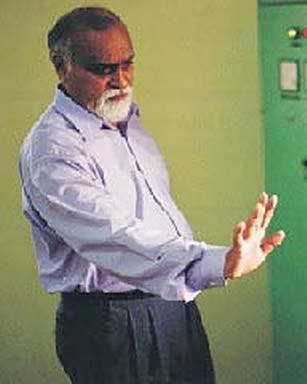
spin. Paramahamsa Tewari
(photo left), an engineer who
did take him seriously, later
came into conflict with the
Indian establishment when he
replicated DePalma’s N-machine
and effectively
improved it (COP 2.5) with
an overunity space energy
generator (a
'Reactionless AC Synchronous
Generator' - RLG), which he
patented as lead engineer at
the Indian Institute of
Nuclear Energy. Bruce de Palma,
the former MIT lecturer, was
ostracized by the scientific
community in the 1960s, more
or less declared mad, due to
his “heretical” experimental
result that undermined
Einstein’s theory of
relativity: a spinning
steel ball travels farther
or shorter than a
non-spinning ball, depending
on the direction of its
spin. Paramahamsa Tewari
(photo left), an engineer who
did take him seriously, later
came into conflict with the
Indian establishment when he
replicated DePalma’s N-machine
and effectively
improved it (COP 2.5) with
an overunity space energy
generator (a
'Reactionless AC Synchronous
Generator' - RLG), which he
patented as lead engineer at
the Indian Institute of
Nuclear Energy.
Finsrud, too, demonstrates
with his gravitomagnetic
device - his “Perpetuum
Mobile” kinetic artwork - that
the inert mass of the ball,
kept out of equilibrium
for 150 hours or more by
the pendulums, through
magnetism, offers extra
energy, or surplus inertial
mass movement, relative to its
own gravitational mass.
Apparently, according to these
two formally unreplicated
pieces of evidence from
Finsrud and DePalma, it is
therefore possible to
experimentally refute the
equivalence principle using
rotations that cannot occur
spontaneously in nature, and
we can thus effectively set
aside the insufficient logic
of the theory of relativity.
But of course, modern physics,
with its idolization of
Einstein as the supreme
intellect, does not want to be
dismissed that way as a double
rationalization of its own
experimental inaptitude. “What
I cannot prove does not
exist, and therefore the
ether does not exist, nor
does a violation of the
equivalence principle”,
is no acceptable reasoning, we
cannot guarantee mental health
that way.
That kind of denial is for a
psychoanalyst more of a
symptom belonging to a
cultural neurosis involving
Oedipal denial and repression
in relation to Father Time,
and such a state of mind -
provided this evidence proves
solid upon replication, at
least - clearly shows
that one with Einstein was in
fact is a scatterbrain and
that Tesla was therefore right
when he spoke of modern
(theoretical) physics as mathematical
mysticism without much
practical insight. Later
in his life, Einstein’s
intellectual faculties also
declined considerably. That
could have been due to old
age, but it is more likely
that his theory, as the
psychological denial of
something, showed no progress.
We thought we were seeing
therewith the absolute speed
of light, but we
ourselves didn’t
really see
the light of the future with
it
other
than in in
flashing mushroom clouds. We
have made practically no
progress beyond GPS technology
and those reprehensible
nuclear power plants, which
are essentially modern steam
engines. Einstein was unable
to untangle the knot he had
created with his initial
rejection of the ether and his
principle of equivalence -
which he elevated to the
status of an axiom - and was
unable to achieve integration
or arrive at a unified theory.
Physics is thus, as it appears
today, a collection of
disparate experimental
insights that, theoretically -
despite all the speculation
and particle accelerator
research - lack unity, and
whose theory reeks of denial
and repression.
The generally authoritarian,
negative character of the
average newly trained
(immature, recent graduate)
physicist - who tends to react
with skepticism and judgment
toward exceptions to the
aforementioned principle, much
as the Inquisition of the
Catholic Church reacted with
murderous and criminal fervor
to spiritual experiments by
citizens (persecution of
heretics - is also cause for
concern. So there must be
something fundamentally wrong
with modern physics education.
It seems like a religious
sermon with dogmatic followers
who aggressively and
defensively try to defend
their highly paid field of
study and dismiss us
“laypeople” as ignorant. Is
physics perhaps the newest
religion? Are we supposed to
just believe all that
incomprehensible “intelligent”
tampering with mathematical
logic? And is television
perhaps the modern idol of
detachment, worshiping the
false unification of standard
time - which is rationally
based on the denial and
removal from its natural
context of the absolute value
of an eternally changing time
that does indeed possess a
momentary absolute equality we
call the NOW - even though
that Now is scientifically
(and not politically) assigned
a different number everywhere
in nature? Surely we shouldn’t
all see it that way… Didn’t
Einstein say that science and
religion couldn’t exist
without each other because he
liked to see physics wield the
sceptre dogmatically? And of
course there are more
enlightened physicists (Bohm,
for example).
Following Einstein’s
“conversion” to a new
understanding of the ether -
when, in 1920, he expressed
regret over his radical
rejection of the ether - the
modern theory of the ether
emerged, which was based in
part on the work of physicist
Wolfgang Pauli (1900–1958),
who, with his exclusion
principle, made a significant
contribution to the quantum
theory of Max Planck
(1858–1945), which does allow
for a type of ether particle
that will be discussed below.
According to the exclusion
principle, normal elementary
particles (fermions) are
absolutely distinct in space
and are therefore always a
time product. Consequently,
the ether
- that
is, the space described by
matter
- is
equally an absolute given. In
quantum mechanics, the ether
is thus, from a theoretical
physics perspective, an
axiomatic given without which
logical reasoning is
impossible. However, the new
ether theory, which was
popularized in the 1980s by
Maurizio Gasperini and brought
back into the spotlight around
the turn of the century by Ted
Jacobson and David Mattingly,
is still not generally
accepted within physics at the
beginning of the 21st century.
This leads to discussions and
attacks on that traditional
relativistic stronghold that
now seems to stand in the way
of progress.
For
example, as recently as
October 2007, there was an
organic-physical chemist in
the Netherlands named Marcoen
Cabbolet (1967) whose doctoral
defense, in the fall of 2007,
wa
- quite
uniquely
- canceled
even though the doctoral
committee had already approved
his dissertation. Together
with his late advisor Sergey
Sannikov from Ukraine, he had
discovered that, contrary to
the principles of quantum
mechanics and general
relativity, there are
theoretically entirely new
sources for energy generation.
The PhD Committee at Eindhoven
University of Technology,
which unanimously ruled that
the research was of
insufficient quality, later
had to reverse that decision
when it turned out that the
committee itself was flawed.
External experts were
consulted, including our 1999
Nobel laureate Gerard 't
Hooft, who said he “couldn’t
make head or tail of it.”
Cabbolet’s research could not
be correct because it would
imply that antimatter has a
positive rest mass, yet moves
away from Earth under the
influence of gravity. But the
supervisor, Harrie de Swart,
stated that the dissertation
consisted of a strictly
logical framework with a
physical interpretation. He
wasn’t crazy, after all.
Cabbolet replied that 't Hooft
was guilty of empty rhetoric
and that he apparently had not
mastered formal logic.
Cabbolet has not had anything
published since then and had
to take a job at KPN in the
user support department.
Among
physically trained free-energy
researchers, in addition to
Tom Bearden and Stefan
Marinov, Prof. Kanarev
- known
for his work on plasma
electrolysis as discussed
above
- is
also highly critical of the
current state of natural
science. Like Marinov, he
argues that we must return to
the classical physics of the
19th century and p ick up the
thread where we lost it.
Following postmodernism, we
are in need of a paradigmatic
restoration to repair the
relationship with the
classical order that was
disrupted in modernity.
Marinov stated in his
scientific testament: "I hope
that the (Newtonian)
concepts of space-time,
which I have restored
through numerous experiments
and a simple mathematical
theory, will soon be
accepted by the scientific
community as those that
correspond to material
reality." Kanarev adds: "I
am thinking of a theoretical
virus called the Lorentz
transformations, on which
the proof of Einstein’s
theory of relativity is
based. In Lorentz’s work,
time and space were
expressed in two separate
equations and kept apart
from one another. Only by
reuniting these two
equations is it possible to
obtain a true description of
the process. Whatever
physical phenomenon might
follow from the descriptions
of Lorentz’s
transformations, it is
impossible to observe it in
nature.” He argues
that in the twentieth
century we began to
misinterpret our research
findings; according to him,
we have overlooked
something." "Time, space,
and matter - these are the
three inseparable elements
of the universe" (see
interview). And this unity,
which was already preached
by the Buddha, is precisely
the point we wish to make in
this chapter. With the
machines of direct energy
extraction, we are dealing
with the free energy of
space. Without viewing time,
matter, and space as a
single, inseparable whole,
we can never master this
science. Not only in
physics, but also in
socio-economics, time and
space have become two
separate concepts in the
twentieth century that no
longer seem to have any
relationship with each
other. And with that, we
have become alienated from
natural reality and from one
another, and we do not truly
have a grip on the material
world. This lack of
social and scientific
coherence regarding these
basic concepts of physics -
the holy trinity of time,
space, and matter - lies at
the root of the fundamental
fragmentation of the old
paradigm of relativism. In
that old paradigm, we deny the
ether, we distort time as
legally defined, and we have
no control over the planet’s
matter, climate, and energy
production. And thus, at the
beginning of the 21st century,
we are on the wrong track
ecologically and
psychologically, trapped as we
are in political, scientific,
and religious egos as if we
were a bunch of sociopaths
with TBR. ick up the
thread where we lost it.
Following postmodernism, we
are in need of a paradigmatic
restoration to repair the
relationship with the
classical order that was
disrupted in modernity.
Marinov stated in his
scientific testament: "I hope
that the (Newtonian)
concepts of space-time,
which I have restored
through numerous experiments
and a simple mathematical
theory, will soon be
accepted by the scientific
community as those that
correspond to material
reality." Kanarev adds: "I
am thinking of a theoretical
virus called the Lorentz
transformations, on which
the proof of Einstein’s
theory of relativity is
based. In Lorentz’s work,
time and space were
expressed in two separate
equations and kept apart
from one another. Only by
reuniting these two
equations is it possible to
obtain a true description of
the process. Whatever
physical phenomenon might
follow from the descriptions
of Lorentz’s
transformations, it is
impossible to observe it in
nature.” He argues
that in the twentieth
century we began to
misinterpret our research
findings; according to him,
we have overlooked
something." "Time, space,
and matter - these are the
three inseparable elements
of the universe" (see
interview). And this unity,
which was already preached
by the Buddha, is precisely
the point we wish to make in
this chapter. With the
machines of direct energy
extraction, we are dealing
with the free energy of
space. Without viewing time,
matter, and space as a
single, inseparable whole,
we can never master this
science. Not only in
physics, but also in
socio-economics, time and
space have become two
separate concepts in the
twentieth century that no
longer seem to have any
relationship with each
other. And with that, we
have become alienated from
natural reality and from one
another, and we do not truly
have a grip on the material
world. This lack of
social and scientific
coherence regarding these
basic concepts of physics -
the holy trinity of time,
space, and matter - lies at
the root of the fundamental
fragmentation of the old
paradigm of relativism. In
that old paradigm, we deny the
ether, we distort time as
legally defined, and we have
no control over the planet’s
matter, climate, and energy
production. And thus, at the
beginning of the 21st century,
we are on the wrong track
ecologically and
psychologically, trapped as we
are in political, scientific,
and religious egos as if we
were a bunch of sociopaths
with TBR.
An
excellent lecture by a
renowned scientist named Tom
Valone is available online,
providing an overview of the
challenges facing science
regarding free energy. Without
delving directly into the
theory, he conducted a major
feasibility study focusing on
the conversion of zero-point
energy, taking into account
recent developments in fields
such as nanotechnology. He
refers to the work of Casimir
(vacuum pressure at the micron
level), Dr. Fabrizio Pinto
(see also video and an
article), Mead, and Milonni,
and he discusses and analyzes
the core principles for
converting energy from the
vacuum. In doing so, he
argues, just like Bearden,
that these principles fall
within the "thermodynamic,
fluid, mechanical, and
electromagnetic domains of the
fundamental force phenomena
applicable to all energy
systems." For example,
he also mentions recent
developments in microdiodes
which, as in Moray’s work,
capture the vacuum energy
that, in principle, fluctuates
randomly but is very real and
not merely virtual, as Bearden
points out in response to many
skeptics. He thus argues that
this also applies to the
quantum level of the
(incomplete) theory of
elementary particles. In
addition to Valone, Bearden
(see especially his videos
*Energy From The Vacuum*; on
Google: part 1 & part 2),
and Kanarev, there are also
individual and institutional
studies by other scientists
grappling with the
paradigmatic energy question:
Lee Felsenstein, who also
studies energy systems for
computers; Prof. Pharis
Williams on alternative
nuclear energy and antigravity
(his site); and Mark Goldes in
his article on Fueling the
Future with Zero Point Energy
(site), to name a few. The
problem with the old paradigm
is that the average person
cannot understand it. Instead,
people experience the chaos of
postmodernism. And what one
does not understand is
difficult to put into
perspective, accept, or
reject. People only know that,
in the current model of
thought, it doesn’t really
matter whether the clock is in
sync with the sundial or not.
With this relativity of the
concept of time, time was
stripped of its classical,
absolute value. The absolute
value of time that I. Newton
assumed implied that the
passage of the sun and moon
entailed an unquestionable,
uniform progression of the
matter of the universe, which
operates completely uniformly
and identically everywhere.
Einstein demonstrated that the
concept of simultaneity,
despite the equality of the
Now, is nevertheless an
illusory idea. As mentioned,
he proceeded from the axiom of
a constant speed of light in
space. Time, he
argued, is always and
everywhere different; it is
entirely relative. He also
explained that the classical
concept of the ether
- the
ether as a separate substance
that is omnipresent
- which
Einstein had deemed
unnecessary in physics by
1920, was relative: having
later changed his mind on this
point, he stated that
according to him, the ether
concerned space with physical
properties, space in the form
of a specific force field that
operates differently for each
planet, star, and galaxy. That
force field makes a difference
in its relationship with the
force field of spacetime,
which represents the expansion
of the universe in a sort of
fourth dimension of time in
which all universes are moving
apart. As for the ether, with
this change in Einstein’s view
in favor of the new, relative
concept of the ether (which he
began in 1916, see Kostro
2000), the problem arose that
we can no longer regard
physics itself as absolutely
valid either (see also the
article on Einstein in the
info section of this site).These are, more
or less, paradigmatic visions,
opinions, or perspectives
- certain
forms of language consisting
of self-defined terms
- that
function just like the
explanatory models of
historians, psychologists,
sociologists, philosophers,
and climatologists, for
example, or as Tesla called
it: a physical belief, a form
of mathematical metaphysics in
which the mystic in question
takes center stage and it all
comes down to the right
conceptual “feel” for the
matter. In physics, too,
opinions, definitions, and
methods vary, and these may
consequently lead to different
research results and measuring
instruments. By accepting a
relative ether, combined with
the rejection of the
relativism that refuses to
acknowledge the ether at all,
the undersigned now boldly
joins the conversation within
this freedom, basing his
argument more on a practical
psychological and classical
philosophical perspective than
on a physically and
mathematically mystified
standpoint, on the measuring
instrument of the tempometer
and the associated conceptual
framework that serves as the
guiding paradigm to string the
arguments together into a
coherent vision.
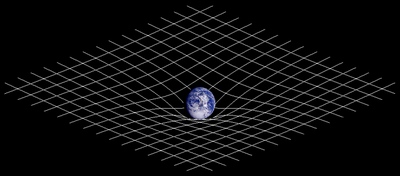
The
Einsteinian "dimple" in spacetime
upon which current
thinking about gravity and the
aether is based.
In
twentieth-century physics, the
idea of the relative ether as
presented here is initially
consistent with what is known as
scalar gravity theory. This is a
theory in which gravity is
described as an invariant field of
particles with zero spin
(so-called bosons) to which the
time/space differences of the
Lorentz equations
- criticized
by Kanarev
- apply.
Around the turn of the century, a
new theory of gravity by David W.
Allan, Ranae Lee, and Jeff Lorbeck
from 1999 emerged. In this theory,
the emphasis is on diallelic
gravitational lines radiating from
the core of all matter (as in our
cakra design for a magnetic
motor). In this view, the four
fundamental forces of nature are
unified into a single unified
field theory. In a more recent
development, since 2002, the term
“Aether Physics Model” has been
used (David Thomson III and Jim D.
Bourassa; see also their book), which constitutes
the third major revolution in
physics after Dalton’s atomic
theory in 1803 and Einstein’s
theory of relativity in 1905. In
this, once again aligning with the
classical ether model, we view
time itself as a form of energy
that precedes the time manifest in
the three-dimensional world:
evolutionarily, the expanding,
linear time of spacetime exists
before the cyclical time of
created matter. There are thus two
fundamental forms of time:
cyclical and linear time. Linear
is the energy of motion that
expands and leads entropically to
chaos, and cyclical is the energy
of a swirling time that leads to
order, to structural phenomena,
and forms patterns
- bodies
of matter with longitudinal and
transverse waves and gravitational
lines and fields consisting of
particles. Viewed in this way,
spacetime is pure primordial
energy that can be expressed
mathematically in the same way
that material energy is expressed
in the equation E=mc². We then
begin the creation with the
equation E=T.e². Energy is equal
to the product of time and the
absolute of expansion (where T is
in fact delta T, or the change in
time; see also the article “Scalar
Wars”). One could also say that
spacetime, the so-called fourth
dimension, is a manifestation of
energy in which time itself is
still the primordial energy, the
dark energy that is in fact merely
a primordial potential of all
cosmic energy in equilibrium. Only when that
energy in the secondary ether (the
ether of contraction) begins to
swirl, becomes unbalanced, or
loses its symmetry - as the 1957
Nobel laureates Chen Ning Yang,
Tsung-Dao Lee, do energy particles
emerge that are initially still
‘uncertain’: gravitons,
gravitational particles, or ether
particles that are nothing more
than small, polar, yet still
chaotic vortices of the primordial
energy of time itself (formally
with a spin of two and not zero).
The Ether Physics Model puts it
this way: 'The Aether has a dipole
of two spheres, which arise as the
oscillation of forward and
backward time.' That graviton
vibration forms the source of
zero-point energy, vacuum energy,
or radiant energy, as Tesla called
it. Or as T.H. Moray put it: "Radiant Energy
is particles of energy, just
as light is wavelengths .." "Uncertain" here
refers to the virtual presence or
absence, visibility, or
measurability of something that
depends primarily on the
measurement method or the paradigm
used: that quantum mechanical
"space foam" which Bearden calls
the "bubbling" of the positive and
negative aspects of the vacuum -
in other words, the boiling or
swirling of vacuum energy. Those
gravitons form islands, or clouds
in primordial space, islands of
gravitational fields or spacetime
dimples, a kind of gravitational
mist (the Greeks called it aether
or vapor). These islands are all
interconnected, as René Descartes
had already posited; he was one of
the first to describe the
self-organizing capacity of the
universe in Part Five of his
*Method* and in his unpublished
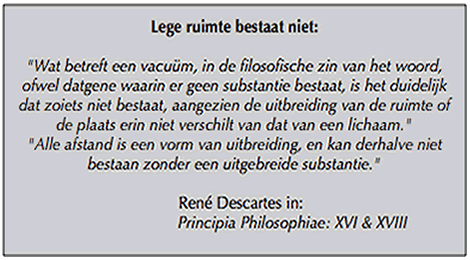
work *Le Monde*. In this context,
he asserted, among other things:
“Empty space does not exist”
(*Principia Philosophiae* XVI
& XVII), as well as that all
that exists is a transformation of
the ether.
A related historical
precursor to the new ether model
is Theodor Kaluza’s (1885–1954)
1921 Kaluza–Klein theory, which
posits a fifth dimension that
unifies gravity with the
electromagnetic force. In this
theory, the fifth, invisible
dimension consists of compacted,
or as the Swedish mathematician
Oscar Klein (1894–1977) called it,
“curled-up” space. The theory was
recently (Sept. 2008) put forward
by the Brazilian scientist Dr.
Keppe in defense of the concept of
energy as the result of the
interaction with, and of, virtual
fields and particles, or of what,
from an evolutionary perspective,
one might call protomatter of a
higher level. According to him,
Einstein’s formula E=mc² has led
us to believe too strongly that we
must have matter in order to
obtain energy. However, matter is
more accurately described as a
condensate of (dark) energy. This
theory, which he put forward along
with the Aharonov-Bohm effect
- which
extracts energy from quantum
potentials and serves as an
explanation for Bearden’s MEG
- would,
in his view, refute that, and his
Bedini-Newman-like super-efficient
Keppe motor (the Keppien Scalar
motor, with energy reduction up to
80%) would constitute the
revolutionary proof of it. This
idea of energy from a dimension
other than the three or four we
know of aligns with the later
string theory, which posits
multiple dimensions (10 in total)
of vibrating, interconnected
“strings” - vibrating,
interconnected energy phenomena -
rather than quanta or energy
packets as fundamental particles.
In this theory, the graviton or
gravitational particle would be an
unconnected, closed vibrating
string that forms space. String
theory thus becomes a Theory of
Everything, a theory that unifies
the four different fundamental
forces of nature. In this context,
the graviton would be merely an
isolated vibration of time energy. Even though,
according to Bohn-Aharanov, the
graviton can be induced to
manifest itself as a spatial
response to a closed magnetic
field, since it is not bound to
the other dimensions, shift
dimensionally, which is why
gravity would be so weak, and
perhaps that is also the reason
for the apparent dimensional
shifting (appearing and
disappearing out of nowhere) of
observed UFOs.
In their
aetheriometrics, the Correas
define it as follows:"Gravitons are
transient, nonelectromagnetic
massfree energy particles
whose impulse (gravitational
momentum) is anchored to the
mass-energy of particles of
Matter, but which are emitted
from the local Aether medium
(formed by the constant and
ordered flux of dark massfree
energy and cosmological lepton
lattices). Both gravitons and
antigravitons may also be
formed and seated in the
composite lattices composing
the local Aether medium.
Gravitons anchored to
mass-energy particles are
described mathematically and
physically as being in a
relationship of secondary
superimposition with that
mass-energy." Whereas
Einstein speaks of a
mass-to-energy ratio, the theory
surrounding the graviton
involves vortices of the
primordial dark energy of time -
that is, a momentum-to-energy
ratio. These vortices evolve
from the islands within the
graviton clouds, giving rise to
the electromagnetic fields in
what Einstein called “curved
space” around the celestial
bodies “condensing” from the
graviton vapor. At the local
level, the gravitons manifest
themselves in that condensation
process in an evolutionarily further
subdivided form: these then form
the electromagnetically active
matter particles in relation to
the third ether, or the local
ether of curved space. Following
the initial expansion of
space-time energy, the second
phase was the distortion of
space-time in the form of
graviton fields, in which the
polarization of gravitons into a
field of attraction led, in the
final stage of evolution, to the
formation of electrons and
protons with opposite charges
(the clockwise and
counterclockwise rotating time
energy in a coil). Those two
fundamental particles then reach
a stable state together with the
neutral component of the
omnipresent space-time. And that
neutral component can then be
identified in the form of the
neutrino particle. In his video
'Cut the cost of oil,' inventor
Joseph Newman speaks of
'gyroscopic electromagnetic
particles' that, when a magnet
moves perpendicular to a coil in
a certain direction, generate
more current from that coil than
is needed to rotate the magnet,
because they then polarize as
they are attracted from outer
space by the rotating magnet. It
is a method of energy production
that works in two directions
with a rotating magnet and thus
demonstrates overunity. In one
direction, we observe only a
transformation of kinetic energy
into electrical energy when we
allow the reverse flow of what
the inventor Gray called
“negative energy” to dissipate
through the Earth as
interference. In the Aether
Physics model, in connection
with the graviton, one speaks of
an “aether unit” with an
internally opposite time
direction consisting of a
positive proton and a negative
electron aspect that
quantum-mechanically mirrors
itself with an antiproton and a
positron (image on the right).
In that aether unit of the
rotating field that forms space,
the Aether Physics model posits
three polarities: the
electromagnetic, the
electrostatic, and the
gravitational force. However,
where the model speaks of
“reverse time” (see image on the
right), we must make a caveat:
time does not, of course, run
backward; it merely changes
direction. In Chapter Two,
we already mentioned that there
is linear and cyclical time.
Cyclical time is the result of a
change in the direction of
linear time - from an
outward-expanding, “forward”
direction of the universe’s
energy to an inward-directed,
“reversed” direction in which
matter ultimately collapses into
itself as a black hole. However,
because expansion predominates,
a balance arises in the form of
the energy, moved to inertia, of
the still-dynamic matter that
exists between expansion and
attraction: cyclic time. So
ultimately, we recognize the
order of time in three forms:
the two forms of linear time and
cyclic time. The three bands
with the three forms of space
and thus also with the three
forms of space-energy that we
are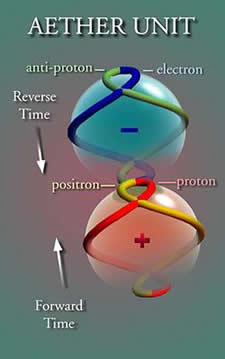 working with in
ether technology and which we
also explained in chapter two.
Zero-point energy thus
represents "forward" time,
vacuum energy represents
"reverse" time, and radiant
energy represents the phenomenon
of cyclical time. The expansion
corresponds to the cosmic
zero-point energetic spacetime,
the attraction to the universal
vacuum space of a galaxy, and
cyclic time is the time
described by the local curved
space of electromagnetic,
radiant-active celestial bodies
revolving around one another.
Cyclical time is thus the time
of matter, and so, from a
scientific perspective, we are
materially bound to the time
described by the sun, the moon,
and the starry sky. This set of
natural rhythms thus forms the
“master clock” that all human
clocks must slavishly follow,
just as in eighteenth-century
France one also spoke of master
and slave clocks at a local or
place-dependent level of
timekeeping. If the clock does
not slavishly follow nature,
then people themselves become
slaves to the culturally
neurotic,
standard-time-political ego
until they have learned their
lesson. After all, you can only
be free with the order of time
if you see that order clearly
before you; otherwise, you
cannot choose whether to conform
or not. Freedom does not lie in
denying or resisting the natural
order with time zones and
averages, but in improvising
individually according to
circumstances. In a system of
denial, there is only the
unconscious compulsion to
conform to a system that is
itself inconsistent; that never
feels right, and it causes
psychological problems. To solve
those problems, we must return
to the natural order of time. It
is easy to do individually - but
not collectively - with a clock
and a calendar that align with
the sun and the moon, but what
is at stake here is more: it
concerns the entire scientific
approach, the conceptual
framework, the paradigm for
dealing with the fundamental
natural forces of time, matter,
and space. The energy concept of
our culturally manipulated time
has become too destructive; it
is too much at odds with natural
reality.And that is why
we are searching for the right
method to solve that problem, as
well as the psychological issue
that goes hand in hand with it.
With relativism, we have reached
an impasse: nuclear power plants
that do not operate sustainably
and sustainable methods that are
not efficient enough. Uranium is
running out, the sun doesn’t
shine everywhere and always with
the same intensity, and so on.
The search for a workable
scientific formula based on
which we can generate free
energy from space as needed -
the most ideal form of
sustainable energy - therefore
boils down to the search for the
operational definition of what
one might call time energy, the
energy resulting from the
interaction of the various
forces - expanding,
contracting, and rotating - of
time in conjunction with the
force field of space, the ether.
An ether machine is essentially
a time machine that operates as
efficiently as possible based on
nature’s tendency toward
rotation. We are searching for a
yet-to-be-discovered law of
nature governing time energy.
This law describes the
relationship between the
parameters of rotation - an
intrinsic aspect of material
nature that is always available
to us. All we need to do is
engage or unleash that rotation
in the correct way, in
accordance with this law, using
our ether machine. So with such
a machine, we do not spin a
rotor; rather, we simply allow
that rotation - from which we
wish to generate electricity -
to occur or give it the right
opportunity. This rotation of
time energy is inherent to the
ether unit, which forms the
non-material, manifest basis of
all material manifestation. The
ether unit evolves with cyclical
time, divided into molecular,
electromagnetically bound
dipoles of nuclei and electron
clouds, all of which possess
spin or rotation. In this way,
the ether machines are somewhat
like clocks: they must all time
the ratios of spatial energy in
order to capture and convert its
drift and dynamics. Since we can
refer to the gravitons, which
are evolutionarily split in
nature, as electromagnetic
matter, one could in principle
use a machine to create all
forms of energy and matter from
the gravitons freely available
in the vacuum as raw material,
in combination with the linear
energy of the neutron. The
replicator from Star Trek
operates on vacuum energy. In
cold fusion experiments, we are
already seeing a kind of
alchemy, or transmutation of
elements, occur with the
unexpected formation of atomic
particles in the vessel that
were not there before. working with in
ether technology and which we
also explained in chapter two.
Zero-point energy thus
represents "forward" time,
vacuum energy represents
"reverse" time, and radiant
energy represents the phenomenon
of cyclical time. The expansion
corresponds to the cosmic
zero-point energetic spacetime,
the attraction to the universal
vacuum space of a galaxy, and
cyclic time is the time
described by the local curved
space of electromagnetic,
radiant-active celestial bodies
revolving around one another.
Cyclical time is thus the time
of matter, and so, from a
scientific perspective, we are
materially bound to the time
described by the sun, the moon,
and the starry sky. This set of
natural rhythms thus forms the
“master clock” that all human
clocks must slavishly follow,
just as in eighteenth-century
France one also spoke of master
and slave clocks at a local or
place-dependent level of
timekeeping. If the clock does
not slavishly follow nature,
then people themselves become
slaves to the culturally
neurotic,
standard-time-political ego
until they have learned their
lesson. After all, you can only
be free with the order of time
if you see that order clearly
before you; otherwise, you
cannot choose whether to conform
or not. Freedom does not lie in
denying or resisting the natural
order with time zones and
averages, but in improvising
individually according to
circumstances. In a system of
denial, there is only the
unconscious compulsion to
conform to a system that is
itself inconsistent; that never
feels right, and it causes
psychological problems. To solve
those problems, we must return
to the natural order of time. It
is easy to do individually - but
not collectively - with a clock
and a calendar that align with
the sun and the moon, but what
is at stake here is more: it
concerns the entire scientific
approach, the conceptual
framework, the paradigm for
dealing with the fundamental
natural forces of time, matter,
and space. The energy concept of
our culturally manipulated time
has become too destructive; it
is too much at odds with natural
reality.And that is why
we are searching for the right
method to solve that problem, as
well as the psychological issue
that goes hand in hand with it.
With relativism, we have reached
an impasse: nuclear power plants
that do not operate sustainably
and sustainable methods that are
not efficient enough. Uranium is
running out, the sun doesn’t
shine everywhere and always with
the same intensity, and so on.
The search for a workable
scientific formula based on
which we can generate free
energy from space as needed -
the most ideal form of
sustainable energy - therefore
boils down to the search for the
operational definition of what
one might call time energy, the
energy resulting from the
interaction of the various
forces - expanding,
contracting, and rotating - of
time in conjunction with the
force field of space, the ether.
An ether machine is essentially
a time machine that operates as
efficiently as possible based on
nature’s tendency toward
rotation. We are searching for a
yet-to-be-discovered law of
nature governing time energy.
This law describes the
relationship between the
parameters of rotation - an
intrinsic aspect of material
nature that is always available
to us. All we need to do is
engage or unleash that rotation
in the correct way, in
accordance with this law, using
our ether machine. So with such
a machine, we do not spin a
rotor; rather, we simply allow
that rotation - from which we
wish to generate electricity -
to occur or give it the right
opportunity. This rotation of
time energy is inherent to the
ether unit, which forms the
non-material, manifest basis of
all material manifestation. The
ether unit evolves with cyclical
time, divided into molecular,
electromagnetically bound
dipoles of nuclei and electron
clouds, all of which possess
spin or rotation. In this way,
the ether machines are somewhat
like clocks: they must all time
the ratios of spatial energy in
order to capture and convert its
drift and dynamics. Since we can
refer to the gravitons, which
are evolutionarily split in
nature, as electromagnetic
matter, one could in principle
use a machine to create all
forms of energy and matter from
the gravitons freely available
in the vacuum as raw material,
in combination with the linear
energy of the neutron. The
replicator from Star Trek
operates on vacuum energy. In
cold fusion experiments, we are
already seeing a kind of
alchemy, or transmutation of
elements, occur with the
unexpected formation of atomic
particles in the vessel that
were not there before.
In summary,
there is a hierarchy of
particles: a - the time particle
of pure energy - the graviton,
which is a double-spin
“uncertain” energy particle of
dual, forward and reverse time;
and finally c - the manifesting
triplicity of that energy in the
vortices of the ordinary
particles that form atoms, atoms
that are then no longer virtual
but visible, atoms that, once
manifested, have entered into a
specific relationship that we
can find in the periodic table
of elements. And so the energy
question then boils down to a
certain ordering of time, much
like a Pythagorean tree grows:
as a fractal that splits further
and further, or like the crop
circle to the left and right at
the top of the page.
Let’s go over
this fundamental line of
reasoning for the new paradigm
once more: at the beginning of
creation, there is first
nothingness - “God’s slumber,”
so to speak - then there is
“awakening,” the linear time of
expanding spacetime: dark
energy, the pure energy of time
that is nothing but linear
expansion. Then, from that
linear time, through a disturbed
equilibrium, through a broken
symmetry, a counterforce arises:
cyclic time, as a division
relative to that primordial
ether. Thus, from space-time,
the three-dimensional space
arises, filled with gravitons or
vortices of cyclic time - pure
time vortices of the primordial
ether. This final phase
of light manifestation is what
is depicted in the timeline of
the cosmic order as currently
conceived by science. In that
view, manifestation occurs from
the very beginning, and dark
energy does not appear until
later. But in a hierarchical
view as presented here, there
are preceding phases, and dark
energy precedes manifestation.
This transitions from E=t.e² to
E=t.d²: time expanding (e²)
first becomes three-dimensional
(d²). Only then does matter
materialize as a further
subdivision of the gravitons in
universal (secondary) space:
they then form the local etheric
spheres of curved (tertiary)
space.

De
tijdlijn van het kosmisch bestel
vanaf de Big Bang volgens het oude
model
This is
consistent with the statement in
physics that "it appears possible
to regard curved spacetime as
consisting of a condensate of
gravitons," which we found on
Wikipedia under the entry for
quantum gravity. The initial
expansion is consistent with
Gurth's inflation theory from
1981. From E=t.d², we have arrived
at E=m.c² with the manifestation
of matter: the time energy E is
the matter M bound to the speed of
light (C²), which is then locally
determined and depends on the
distance to the singularity to
which it seeks to return in order
to find its original energetic
equilibrium. As we saw earlier,
the constant speed of light in the
new paradigm is a relative
constant and not an absolute
constant. It is, in fact, the time
fac tor that
constitutes the constant of change
in the three basic equations used
to describe the various energy
fields of the relative ether. The three forms of
ether - that of expansion (e2),
that of dimensionality (d2), and
that of the speed of light
relative to manifest matter (C2) -
are thus present as the neutral,
positive, and negative particles,
respectively, from which our
ordinary matter is composed. The
expansion thus remains constant,
and so all matter and space grow
constantly, even though the ratio
remains the same. The distance
between the Earth and the Moon,
which increases by a few
centimeters each year, could serve
as a measure of that growth.
Neutrons are constantly being
formed from the expansion of the
primordial ether, which combines
with the free gravitons of space
to form matter. This new matter
is, at the atomic level, a clone
of all existing forms of matter,
which then retains the same
relative shape. On the planets,
one can see signs of this in the
form of cracks in the surface. Such striae or
cracks can also be seen on the
Moon alongside ridges several
kilometers long that formed a
billion years ago when the Moon
temporarily contracted and
cooled. After [and before] a
period of contraction, expansion
may very well have occurred.
This view also offers an
alternative explanation for
continental drift on Earth,
which can easily be assembled
into a seamless sphere, as comic
book artist Neal Adams
demonstrates on his website. The
theory originates from the
Australian geologist Samuel
Warren Carey (1911–2002), who
has been forgotten in favor of
the now-dominant theory of
continental subduction - the
stretching and sliding of
continental plates under the
influence of convection currents
within the Earth. That theory
could not explain the increase
in water. But, if the entire
universe is constantly expanding
more than it is contracting -
which is a proven and accepted
fact within mainstream physics -
why wouldn’t a planet expand as
well? It simply makes
sense. With the expansion of all
matter in mind, we see lakes and
rivers growing into oceans and
landmasses drifting apart like a
crust that is too tight around a
Japanese nut. From a magnetic
perspective, with this constant
expansion, the entire creation
forms a gigantic monopole that
serves as the basis for the
extraction of vacuum or ether
energy. There is always free
energy because there is always the
movement of the expanding
manifestation that seeks to return
to its primordial source, to its
singularity. It is through the
interaction of the three basic
forms of the ether in the form of
elementary particles that a
dynamic interplay of expansion and
contraction occurs, a kind of
constant integrity tension of all
matter in the local ether which,
on its way back to its origin, is
then, under the influence of that
constant pressure, in a cyclical
motion in free space. This local
ether thus constitutes a kind of
fourth, holistic particle of
matter that preserves the
integrity of the relationships
between matter - composed of
protons, neutrons, and electrons -
and space: we shall refer to this
particle as the integron. Prior to
manifestation, space consists of
gravitons and universal ether
particles, the virtual plus and
minus particles that Tom Bearden
calls photons and antiphotons.
Upon the manifestation of matter,
the gravitons split into protons
and electrons, and the universal
ether particle - the counterpart
of the graviton - then splits into
a local ether particle or an
integron striving for integrity,
and a neutron that forms the local
representation of the expanding
primordial ether. Thus, the four
elementary particles, together
with the relative, dynamic ether,
form a parallel to the four
fundamental forces known to
physics: gravity (the graviton),
the electromagnetic force (the
electrons and protons), the strong
nuclear force that holds
everything together (the
integron), and the weak nuclear
force (the neutron, which
eventually always leads to
scattering and decay). To put it
simply: first there is time, then
its vortex, and then its division
into the three fundamental
particles of matter plus a
holistic integrity effect that can
also be described as the local
ether particle or integron. The
ether particles are always part
and whole, are “part and parcel,”
or holon particles - after the
holon as the Hungarian polymath
Arthur Koestler (1905–1983) and,
more recently, the holist Ken
Wilber defended it as a
philosophical concept. The triple holon
particle of the ether in our
theory (triple in the three levels
of the ether’s manifestation)
serves as a model for the
individuality of all organisms, or
for the integrity of the
materially manifested persons that
we ourselves are. Where Wilber
speaks of four quadrants in this
regard, representing the
dimensions of the individual
versus the collective and the
internal versus the external, we
distinguish the matter here more
in terms of quantity and quality
(i.e., the individual/ social
versus the concrete/abstract) in
the fields of action that must
guarantee a person’s integrity in
relation to the order of time and
the forces of the ether.
Ultimately, the description of the
manifest world is about dispelling
the illusion that constitutes a
difference between the inside and
the outside. It concerns the order
of life, the order of time that in
fact constitutes matter - the
matter we know, in relation to
space, as an ethereal interplay of
forces. tor that
constitutes the constant of change
in the three basic equations used
to describe the various energy
fields of the relative ether. The three forms of
ether - that of expansion (e2),
that of dimensionality (d2), and
that of the speed of light
relative to manifest matter (C2) -
are thus present as the neutral,
positive, and negative particles,
respectively, from which our
ordinary matter is composed. The
expansion thus remains constant,
and so all matter and space grow
constantly, even though the ratio
remains the same. The distance
between the Earth and the Moon,
which increases by a few
centimeters each year, could serve
as a measure of that growth.
Neutrons are constantly being
formed from the expansion of the
primordial ether, which combines
with the free gravitons of space
to form matter. This new matter
is, at the atomic level, a clone
of all existing forms of matter,
which then retains the same
relative shape. On the planets,
one can see signs of this in the
form of cracks in the surface. Such striae or
cracks can also be seen on the
Moon alongside ridges several
kilometers long that formed a
billion years ago when the Moon
temporarily contracted and
cooled. After [and before] a
period of contraction, expansion
may very well have occurred.
This view also offers an
alternative explanation for
continental drift on Earth,
which can easily be assembled
into a seamless sphere, as comic
book artist Neal Adams
demonstrates on his website. The
theory originates from the
Australian geologist Samuel
Warren Carey (1911–2002), who
has been forgotten in favor of
the now-dominant theory of
continental subduction - the
stretching and sliding of
continental plates under the
influence of convection currents
within the Earth. That theory
could not explain the increase
in water. But, if the entire
universe is constantly expanding
more than it is contracting -
which is a proven and accepted
fact within mainstream physics -
why wouldn’t a planet expand as
well? It simply makes
sense. With the expansion of all
matter in mind, we see lakes and
rivers growing into oceans and
landmasses drifting apart like a
crust that is too tight around a
Japanese nut. From a magnetic
perspective, with this constant
expansion, the entire creation
forms a gigantic monopole that
serves as the basis for the
extraction of vacuum or ether
energy. There is always free
energy because there is always the
movement of the expanding
manifestation that seeks to return
to its primordial source, to its
singularity. It is through the
interaction of the three basic
forms of the ether in the form of
elementary particles that a
dynamic interplay of expansion and
contraction occurs, a kind of
constant integrity tension of all
matter in the local ether which,
on its way back to its origin, is
then, under the influence of that
constant pressure, in a cyclical
motion in free space. This local
ether thus constitutes a kind of
fourth, holistic particle of
matter that preserves the
integrity of the relationships
between matter - composed of
protons, neutrons, and electrons -
and space: we shall refer to this
particle as the integron. Prior to
manifestation, space consists of
gravitons and universal ether
particles, the virtual plus and
minus particles that Tom Bearden
calls photons and antiphotons.
Upon the manifestation of matter,
the gravitons split into protons
and electrons, and the universal
ether particle - the counterpart
of the graviton - then splits into
a local ether particle or an
integron striving for integrity,
and a neutron that forms the local
representation of the expanding
primordial ether. Thus, the four
elementary particles, together
with the relative, dynamic ether,
form a parallel to the four
fundamental forces known to
physics: gravity (the graviton),
the electromagnetic force (the
electrons and protons), the strong
nuclear force that holds
everything together (the
integron), and the weak nuclear
force (the neutron, which
eventually always leads to
scattering and decay). To put it
simply: first there is time, then
its vortex, and then its division
into the three fundamental
particles of matter plus a
holistic integrity effect that can
also be described as the local
ether particle or integron. The
ether particles are always part
and whole, are “part and parcel,”
or holon particles - after the
holon as the Hungarian polymath
Arthur Koestler (1905–1983) and,
more recently, the holist Ken
Wilber defended it as a
philosophical concept. The triple holon
particle of the ether in our
theory (triple in the three levels
of the ether’s manifestation)
serves as a model for the
individuality of all organisms, or
for the integrity of the
materially manifested persons that
we ourselves are. Where Wilber
speaks of four quadrants in this
regard, representing the
dimensions of the individual
versus the collective and the
internal versus the external, we
distinguish the matter here more
in terms of quantity and quality
(i.e., the individual/ social
versus the concrete/abstract) in
the fields of action that must
guarantee a person’s integrity in
relation to the order of time and
the forces of the ether.
Ultimately, the description of the
manifest world is about dispelling
the illusion that constitutes a
difference between the inside and
the outside. It concerns the order
of life, the order of time that in
fact constitutes matter - the
matter we know, in relation to
space, as an ethereal interplay of
forces.
In summary, evolution proceeds
from potential time-energy,
through the stage of actual,
“dual” gravitational energy, to
the final stage of electromagnetic
energy - which is both
differentiated and maintained as a
holistic whole - the manifest
energy of matter. Each
evolutionary step reveals a new
form of the relative ether, which,
through interaction, constitutes
the entire manifestation: the
primordial ether, the universal
ether, and the local ether - or,
as Einstein puts it: spacetime,
normal three-dimensional space,
and the curved space surrounding
celestial bodies. If we focus too
much on the holon particles, we
are holists, but if we view the
counterpart of those particles
alongside the particles of the
normal ether and take into account
the energetic effects over time in
the fields of action that this
produces, we are philognosists -
people who can also unite
spiritually in the love of
knowledge. And this
hierarchical reasoning is
consistent with the conclusion
reached by the many classical
sages and scholars of the past
who, like Descartes, consistently
maintained that all matter is a
transformation of the ether. Thus,
Vyâsadeva states in the Brahmâ
Sûtra (Adh2. P3: 1-7) that the
pradhâna - or undifferentiated -
ether is the first effect of
creation, after which the other
elements of the local order
appeared, first the air (the
“vapor”), and then fire, water,
and earth (Bhâgavata
Purâna 3.5: 32-36).
A
tectonic fault line on the Moon
that serves as evidence of the
constant growth of planets and
other celestial bodies.
What is called
antimatter - and is posited by
modern physics as a necessary
counterpart to the material
development of time-energy as
described above, Wilber’s “inner
side,” so to speak - must undergo
a corresponding evolution. Given
our hierarchical classification,
we cannot truly speak of an
“anti-universe.” The material can
be traced back to the same
primordial source as antimatter.
Both strive for unity and form
only a primary duality in the
universe, a duality that we
already find as a necessity in the
world’s oldest writings. God, as
the integrity of the greater
whole, as a person, would have
existed from the beginning of
creation according to ancient
conceptions. That God cannot be
seen and is timeless. The
spiritual, with God, forms the
timeless counterpart to matter,
which, however, also comes from
God. Matter forms the visible body
of the God who states that you are
not your body; matter is the
gigantic form of the virâtha
rûpa, as stated in the Bhâgavata
Purâna
2.1. That God
constitutes self-awareness as the
counterpart to space-time. And
that self-awareness reveals itself
only secondarily as the duality of
an ego in relation to the eternal
bliss and love of God. The ego, or
sense of self - which, when not
identified with matter, is also
called the individual soul - is
known in the third instance, that
is, yet another level of
manifestation further, through the
two elements of spirit and
intelligence via the process of
identification, a process
sometimes called the falsification
of the ego (ahamkâra). The
counterpart to this is formed by
the duality of man and woman, the
god and the goddess, who live
their love lives in bliss. And
that love must, proceeding toward
the unseen God, return once more
to a shared self-awareness, a
self-awareness governed by the
Super-soul of the original person
or integrity of the universe. In
the meditations, the mind then
becomes the enemy that must be
subdued through intelligence and,
turned inward, guided back to
self-awareness via true
self-realization. And that
self-awareness can in turn be
traced back to the primordial
unity of God, the original soul
that is physically called the
singularity.
And so there is an equally
complex, parallel, mental, or
spiritual reality that exists more
as a timeless diversity above or
alongside matter - as a reflection
of it - than as a reality opposed
to time. Thus, we speak of a
material world and a spiritual
world, a fundamental duality of
realms of existence between which
one moves in life. If we want a
theory of everything, these worlds
must be combined within this
hierarchical-structural vision of
the person and matter, within this
new paradigm for the world order,
so that everyone has a place in
it, so that everyone can be
respected, and so that conflicts
can thereby be ended. Similarly, a
cell biologist like Bruce Lipton
speaks of a new paradigm in which
science and spirituality converge,
after he discovered that the cell
membrane of a cell in an organic
body transmits information to the
cell’s contents, in other words,
that we ourselves, as well as our
place in the universe, determine
our physical material order, even
at the cellular level, and that
genes do not so much command us
but rather stand ready to serve
us. The protein switches that
govern our lives, he found, are
primarily controlled by stimuli
from outside the cell - by
ourselves, by the environment, by
the universe. The two worlds need
each other and cannot exist
without one another, just as space
cannot exist without matter and
time, and just as classical
physics cannot do without
antimatter. The entirety of
hierarchical particle theory can
then be represented as follows:
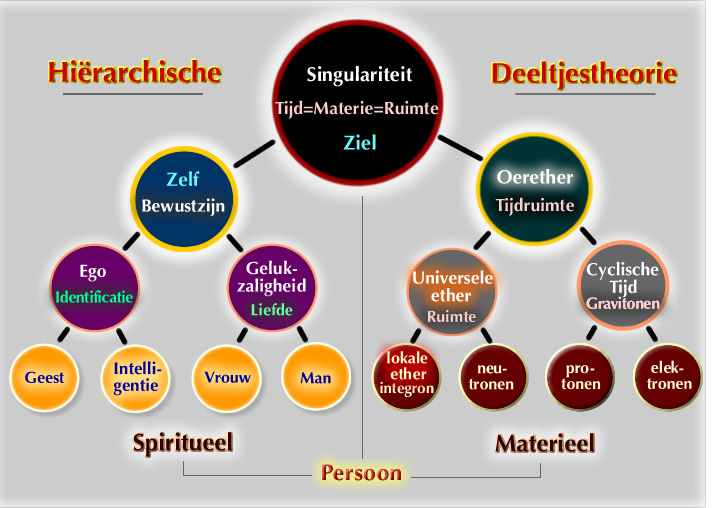
Starting from a
single soul or all-connecting self
that underlies the entangled
spiritual/material quantum reality
of what is also known as Ervin
Laszlo’s information-bearing Akashic
field or the Aeon Game, the game of
the complex relativity of the
hierarchical ‘conical matrix’ of the
psychomatter of spacetime as
formulated in the Aeon Theory by the
French physicist Jean Emile Charon
(1920–1998), the HDT leads us to a
pyramid that describes the entirety
of reality and thereby offers an
alternative vision of the
development, function, and meaning
of consciousness and the theory of
evolution, as we have come to view
them differently since Teilhard de
Chardin (1888–1955) spoke of the
evolution
of consciousness as well (see also a
lecture by Gerrit Teule - “What
Darwin Could Not Know” - based on
his book on this subject). It is, in fact, a
double Tetraktys, a double 1-2-4-8
version of the Pythagorean 1-2-3-4
symbol for the cosmos. In this
triangle, which in the HDT
represents both the manifest and the
non-manifest, the order of the
gradual, evolutionary emergence - in
succession from the monad - of the
dyad, the triad, and the tetrad as
the basic division of creation is
revealed. Respectively, these four
traditionally represent the
singularity of the primordial
beginning of having zero dimensions,
the unity; the duality of one
dimension, of a line, of the
polarity of the world; the
triplicity of two dimensions, a flat
plane, a balance of polarities in
the word; and the quadruplicity of a
three-dimensional world consisting
of the four basic elements or
fundamental forces of nature. The
esoteric Pythagoreans even swore an
oath to this symbol of eternal
renewal: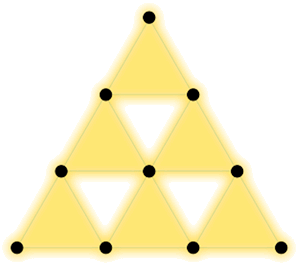
Nay!
By him that gave
our family the Tetractys,
which holds the Fount and Root
of everflowing Nature.
(Ou ma
ton hameterai geneai
paradonta Tetraktun, Pagan
aenaou Phuseôs Rhizôma t'
ekhousan).
For the new energy
paradigm, which we now understand as
a theory of quantum gravity, we
therefore absolutely need the
concept of the ether - that is, the
concept of the ether as proposed by
Einstein after 1920, who defended
the ether as being relative, because
the concept of the ether simply
describes in a single term the
collection of natural forces and
fields - or “spacetime ripples” - as
we described earlier when discussing
the natural primordial sources of
energy that cannot be traced back to
any other source. The collective
term for the natural energy sources
from which we draw energy through
direct conversion rather than
indirect transformation of the
energy freely available in nature -
as we propose here - is the ether,
the ether that we, together with
Einstein, define as space with
material properties or as a force
field, and not so much as a uniform,
omnipresent substance. With the new
machines, we can thus speak of ether
machines.
These machines, as discussed in the
previous chapter, relate to one of
these three basic forms of ether, or
to a combination or interaction of
the fundamental forces of nature
with them - clarifying this matter
requires further clarification and
investigation.
The new way of
thinking must ultimately explain the
various effects discovered by the
inventors. An answer must be found
to the question of how we can, in
addition to what we saw in the
section on unexplained phenomena
(UFOs, crop circles, and aliens),
explain the findings of the
discussed experimental effects
within a single coherent framework.
i)
The Stubblefield effect of
electricity generated from the
Earth’s magnetism.
ii) The Keely effect of energetic
processes and antigravity
resulting from the control of
sound frequencies.
iii) The Reich effect of orgone
energy from crystal configurations
with tubes and temperature
differences between organic and
inorganic matter.
iv) The radiant Tesla/Moray effect
of the energy from plates or rods
that charge themselves
electrically from nature, which
may consist of different metals or
alloys.
v) The Papp effect of noble
gases discharging with an impulse in
a pressure chamber.
vi) The Gary/Finsrud effect of
continuous motion resulting from the
interaction of magnetic force and
gravity.
vii) The
Gray/Johnson/DePalma/Tewari/Bedini/Bearden
effect of a magnetic overunity
torque with a backward energy peak
following interrupted
(electro)magnetic fields in motors
operating on the basis of
(electro)magnets.
viii) The electrostatic Baumann
effect of overunity static
electricity generated via a
Whimshurst-like setup combined with
a storage unit.ix) The cold fusion
plasma process, or the electrolytic
production using steel electrodes of
a Meyer/Williams/Kanarev effect
involving HHO gas or Brown’s gas
generated with overunity efficiency
from pure water without
electrolytes, including the
properties of flammable, charged
water or water vapor.
x) The
Schauberger/Frenette/Griggs vortex
effect of energy generated from
vortices of water, air, or oil.
xi) The Hutchison effect of
antigravity using electromagnetic
vibrations and energy from
compressed crystals.
xii) The Searl/Sweet effect of
energy generation and antigravity
through vibrating magnetic fields or
rotating, diallel-arranged, and
electrically controlled magnetic
fields.
According to the theory, there
may first be a primary effect
resulting from the researcher’s
mindset. It is not uncommon for the
effects to be difficult to replicate
or unstable, even in the hands of the
inventor himself. It requires constant
conviction and sound experimental
discipline to oversee and control
everything in the frontier of science
formed by this field of research. The
influence of the factors of time and
regularity should not be
underestimated, as they are difficult
- even for a physicist - to separate
from the electromagnetic environment
of which the researcher himself, with
his body and conditioning, is a part. The effects observed
by Johnson, Hutchison, Sweet,
Keely, and de Palma appear to be
examples of problems in this
category. The influence of the
experimental setup is consistent
with a finding in quantum theory, in
which the influence of the
experimenter could not be ruled out.
In the so-called double-slit
experiment (see image on the right,
video), electrons, photons, and even
some molecules behave like waves
with an interference pattern, as if
they were part of the ether, when
they are sent through two slits. But
when measurements were taken to
observe exactly what was happening,
they suddenly behaved like particles
without that interference pattern. The measurement thus
determined the outcome of the
experiment; the ether did not
manifest itself when one attempted
to measure it. This gives us pause
when working with our ether
machines. With this new approach, as
Tewari also discusses, a certain
mindset - combined with a specific
temporal order and discipline of
spatial and material self-control -
is indispensable. If order is not
maintained mentally and
intellectually, or if a certain
logic or reason is not followed, the
hierarchical logic on the material
side will also be undermined, and
intelligence will not function
properly at that point. Because the
researcher - and later the user as
well - is part of the application,
he must adapt his methodology of
research, education, and use. This
is an issue that also falls within
the scope of behavioral science
research in psychology. At this
point, we can say that, with our
bodies, we ourselves are ether
machines that interact with similar
mechanical constructs. Inventing a
self-propelled ether machine is more
or less equivalent to developing
self-knowledge and
self-actualization in a process of
emancipation. One develops a system
involving the ether that only
becomes real when one acts in
accordance with it, whether or not a
mechanical application is involved.
We are thinking here of the way in
which the Baumann effect (viii)
exists in the world. Certain forms
of energy use apparently require a
certain mental discipline and
harmony with the ether, and so it
may well be that we must add this
argument to our four reasons for why
this technology cannot simply be
introduced to the general public -
specifically as an addendum to
argument 1: our community’s
discipline regarding time and the
ether may not meet the conditions
under which we can apply this
technology. It is perhaps no
coincidence th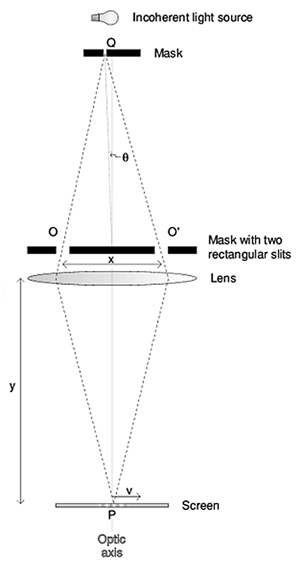 at the undersigned
himself maintains an alternative
sense of time and is thus able (to a
certain extent) to bring order to
this matter. It does not sound
illogical that the penetration of
this new technology into science
also depends on the discipline of
the scientist himself. As long as
that discipline does not improve,
neither will the result of the work
nor the fate of the world associated
with it. The world will only be
better off if we behave better with
it. Naturally. It seems that Prof.
Kanarev is correct when he states:
if we do not treat time, space, and
matter as a holy trinity of physics,
then we fall, even scientifically,
into the incoherence and chaos of
isolated phenomena that are
paradigmatically incomprehensible
and that thus make the matter seem
more like an individual skill than a
form of technology or science that
functions independently of
individuals. Without being united in
a proper temporal order and mastery
of the forces of the relative ether
(as a yogi can be), one may give up
too quickly on developing in this
area; one easily becomes the victim
of certain psychological issues
arising from the tension between
natural temporal conditioning and
culturally bound temporal
conditioning, and we build nothing
and even lose the synergy to live
together because the energy or
attention goes ‘elsewhere.’ And as a result, we
fall into disbelief and skepticism,
bringing us back to the first of the
four obstacles. If, on the spiritual
side of the temporal phenomena of
the relative ether, we must take
into account different levels and
methods of mastering ourselves with
the forces of the ether, then on the
material side there are naturally
also different types of ether
machines or other transformations of
primary energy that depend on and
are suited to different individuals
and communities. A saint can
sometimes levitate on their own -
something the Pope hates, by the way
- while an ordinary citizen would
likely need to obtain a special
pilot’s license to be allowed and
able to operate an anti-gravity
vehicle. Let us attempt to describe
the possible forms of understanding
and control, thereby testing the
explanatory power of our
hierarchical particle theory (HDT). In doing so,
we will partly recapitulate what has
gone before and then proceed
speculatively and abstractly in our
attempt to organize and explain the
effects of the ether machines and to
attribute properties to the various
forces and particles of matter that
play a role in these processes. What
follows is therefore a preliminary
description, an initial assessment,
or a general outline of the order of
nature with which we are dealing. We
do not intend to discuss the
entirety of quantum physics here,
with all its fine subdivisions. That
is the domain of theoretical
physics. at the undersigned
himself maintains an alternative
sense of time and is thus able (to a
certain extent) to bring order to
this matter. It does not sound
illogical that the penetration of
this new technology into science
also depends on the discipline of
the scientist himself. As long as
that discipline does not improve,
neither will the result of the work
nor the fate of the world associated
with it. The world will only be
better off if we behave better with
it. Naturally. It seems that Prof.
Kanarev is correct when he states:
if we do not treat time, space, and
matter as a holy trinity of physics,
then we fall, even scientifically,
into the incoherence and chaos of
isolated phenomena that are
paradigmatically incomprehensible
and that thus make the matter seem
more like an individual skill than a
form of technology or science that
functions independently of
individuals. Without being united in
a proper temporal order and mastery
of the forces of the relative ether
(as a yogi can be), one may give up
too quickly on developing in this
area; one easily becomes the victim
of certain psychological issues
arising from the tension between
natural temporal conditioning and
culturally bound temporal
conditioning, and we build nothing
and even lose the synergy to live
together because the energy or
attention goes ‘elsewhere.’ And as a result, we
fall into disbelief and skepticism,
bringing us back to the first of the
four obstacles. If, on the spiritual
side of the temporal phenomena of
the relative ether, we must take
into account different levels and
methods of mastering ourselves with
the forces of the ether, then on the
material side there are naturally
also different types of ether
machines or other transformations of
primary energy that depend on and
are suited to different individuals
and communities. A saint can
sometimes levitate on their own -
something the Pope hates, by the way
- while an ordinary citizen would
likely need to obtain a special
pilot’s license to be allowed and
able to operate an anti-gravity
vehicle. Let us attempt to describe
the possible forms of understanding
and control, thereby testing the
explanatory power of our
hierarchical particle theory (HDT). In doing so,
we will partly recapitulate what has
gone before and then proceed
speculatively and abstractly in our
attempt to organize and explain the
effects of the ether machines and to
attribute properties to the various
forces and particles of matter that
play a role in these processes. What
follows is therefore a preliminary
description, an initial assessment,
or a general outline of the order of
nature with which we are dealing. We
do not intend to discuss the
entirety of quantum physics here,
with all its fine subdivisions. That
is the domain of theoretical
physics.
The concept of
the ether, as we are initially
familiar with it from radio
transmission, applies to the various
force fields found around planets
and stars. This initial concept of
ether is derived from what Einstein
called curved space, the “dimples”
in spacetime, and thus we are
referring to the local ether.
According to the HDT, the curved
space of the local ether is nothing
other than the residual product of
the materialization process in which
gravitons polarize. The local ether
(the integron) forms the integrity
of atoms consisting of protons,
electrons, and neutrons. The
integron, as it were, forms the
surface tension of the
material world. The neutron is
the anti-integrity particle that, as
the counterpart to the local ether
particle or integron, keeps the
protons and neutrons separated in
the nucleus of the atom. The neutron
seeks to transform the cyclical time
of a local material particle into a
linear time particle. One could also
call the neutron an anti-integron.
The neutron is, as it were, a small
fragment of the holistically
permeated, linearly expanding
space-time known in India as
pradhâna. The polarity of the atom
prevents the neutron and the
integron of the local ether from
canceling each other out and
dissolving into universal space. The
gravity surrounding a planet is the
result of the sum of the force of
the integron - a relative measure
that depends on the universe and
one’s position within it -and that
force leads to a condensation of the
gravitons, attracted by the
neutrons, the individual ether
particles that permeate the matter
and exert a certain pressure upon
it. Gravity is in fact zero-point
magnetism, the unipolarity of the
vacuum, a universal monopole that
exists by virtue of the fact that
there is more expansion than
contraction in the universe, and
electricity is nothing other than
polarized gravity. The ether machine
converts gravity into electricity by
making the linear integron of
gravity cyclical. With such a
machine, one thus converts the
graviton pressure of the integron
into usable energy; one simply gives
a twist, so to speak, to that linear
space-energy, which is in fact
overunity time-energy. With the
magnetic polarization of the
graviton, we then observe electrical
phenomena, and vice versa. This is
the HDT perspective on the
relationship between gravity,
magnetism, and electricity, which we
will need to work with in the
following. In this perspective, the
polarization of the graviton
logically always results in a
bipolar magnetic field; after all,
the unipole of space - which
manifested as the integron of
gravity - was split. This gives us
an idea of the interplay of forces
we are dealing with in this
research.

For the sake of convenience, we’ll
refer to the individual force -
the intensity of the graviton - as
“normal” on a scale of five. The
scale consists of infinite, hyper,
super, normal, and zero. We call
the force of the universal
monopole “hyper” and that of the
original spacetime “infinite.” We
call the force of the proton and
the electron “super”; the
hyperforce of universal space and
the normal force of the ether
particle combine, upon
polarization of the graviton, into
two oppositely rotating
superforces that are kept separate
by the neutron, which, as a
particle, has no effective force.
The only force of the neutron
consists of its ability to be
anti-integer or dissipative as the
local representative of
time-space; in relation to the
other two material particles, it
has no charge or intensity. It is
an antiholon particle that exists
only in relation to the integron,
which has an opposite time
direction or mass, and, like its
counterpart, exerts no (cyclic)
force, has no intensity, and
possesses neither spin nor charge.
We call the cyclical a force
because the cyclical is always
linked to manifestation, whereas
this is not necessarily the case
with the evolutionarily older
space-time and its ethereal
counterpart in the universal
ether. So there can be mass - a
direction of time - without
manifestation: dark energy. The
linear does not constitute a
directly usable force; the inward-
and outward-directed linear space
are, more or less, the father and
mother of all forces. Force, and
thus also intensity, manifests as
a form of resistance against those
parents, as a certain relationship
of the manifested in relation to
that fundamental linear duality;
the manifested, which is itself
always cyclical in nature, plays a
game with it, as it were, at the
interface of existence, the
membrane of the here and now that
we call reality. A spatial particle
that acquires a charge, as is the
case with a magnetic field, is
therefore not an integron but a
graviton, which inherently
possesses a chaotic charge and
spin and a normal intensity. The
graviton and the integron are
related vertically. You must think
vertically, not horizontally, to
understand this. They can lead to
one another, just as elements in
chemistry can combine or be
separated; however, this involves
a hierarchical evolutionary
process of materialization and
dematerialization. If you
accelerate neutrons in a cyclotron
or deploy them with a weapon, you
will always receive other “chaos
particles” in return that exhibit
a mathematical relationship to the
forces that wer e applied. One
never really has a single neutron,
but rather the effect of the
destruction caused by it or of it
itself. Similarly, one cannot
detect the graviton as an
independent particle in a particle
accelerator because, once it is
given mass and direction through
its velocity, it simply can no
longer be a graviton. The machine
destroys the very definition of
such a massless, chaotic spatial
particle. We will leave aside here
the detailed description of the
fine-grained particle physics of
bosons and fermions. The primary
focus is on a general outline of
the logic of the fundamental
relationships of the forces of
nature in the form of particles,
not on experimentally discovered,
more or less self-created,
exceptions to or refinements of
that logic. That is why one also
speaks of push-pull rotation
technology. e applied. One
never really has a single neutron,
but rather the effect of the
destruction caused by it or of it
itself. Similarly, one cannot
detect the graviton as an
independent particle in a particle
accelerator because, once it is
given mass and direction through
its velocity, it simply can no
longer be a graviton. The machine
destroys the very definition of
such a massless, chaotic spatial
particle. We will leave aside here
the detailed description of the
fine-grained particle physics of
bosons and fermions. The primary
focus is on a general outline of
the logic of the fundamental
relationships of the forces of
nature in the form of particles,
not on experimentally discovered,
more or less self-created,
exceptions to or refinements of
that logic. That is why one also
speaks of push-pull rotation
technology.
The pressure
exerted by gravitons in the form
of the integron is the reason why
the ether is relative and not
homogeneous. The difference
between the integron and the
graviton is that the integron has
a linear function, whereas the
graviton is cyclic. The linear
integron is the local
representative of the cyclic
universal ether, of which the
graviton is the individual
particle that rotates (has spin)
and forms a dual polarity in the
form of the alternating positive
and negative “foaming,”
'bubbling,' or 'boiling' of space
as undirected or 'uncertain'
(time) energy. The integron, like
the neutron, is mass without
manifestation, except that the
neutron has a mass we call one
plus a nihile fraction heavy,
while the integron forms only a
nihile-heavy fraction that exists
thanks to manifestation. The
nihile is the difference that
arose from the broken symmetry of
the singularity from which
everything emerged since the
“awakening of creation” (why a
bang?); the nihile constitutes the
difference between everything (1)
and nothing (0). The nihile is the
overunity of the universe that we
are seeking with the ether
machines. It is zero-point energy
that is not directly accessible or
usable without giving it a
“twist.” But to say that this
energy does not exist is the same
as saying that gravity does not
exist. Gravity is the normal
manifestation of zero-point energy
at the local level. That is why
the gravity wheel and the machines
developed by Gary and Finsrud (vi)
- which counteract gravity using
magnetic force - also belong to
the category of ether machines.
The term “gravity” is, in fact, a
misnomer. It creates a linguistic
paradox: gravity is a force that
does not simply constitute an
effective, usable source of power,
and yet it is not a force in the
traditional sense either. It is a
force that is not truly a force,
but merely constitutes spatial
pressure or “gravitational” force.
The force of the gravity of
something is the manifestation of
the imbalance of the universe. A
dam generates electricity from
hydropower, not from gravity.
Hydropower actually comes from the
sun’s energy, which evaporated the
water; when this water condenses
and flows down from a higher
elevation, it is released again as
we block that flow with a dam. In
fact, when we measure mass, we are
not measuring the gravitational
force of an object, but rather the
inward-directed, negentropic time
direction of a material object,
which depends on its distance from
the planet or whatever generates
gravity. Move a little further
into space, and that force is
gone. What is sometimes present
and sometimes absent, we call an
illusion - an illusion of force,
in this case. What truly exists is
the integron, the surface tension
of manifestation. The integron
constitutes a linear time-energy
that contracts in parallel at a
single point, rather than a force
that invariably produces a
measurable weight. In space, there
is no discernible surface tension
beyond the cohesion of matter, and
thus there is no weight either. In
space, there is a balance of space
particles, of gravitons, which are
then undirected and cannot find a
significant surface of attraction
to manifest the integron of
overunity to such an extent that
there would be anything like
gravity or direction. The ether
machine brings order to the chaos
of the free space particle known
as the graviton. Finsrud
deliberately introduces a
mechanical order into gravity by
first setting up the magnetic
force chaotically with his central
pendulum and then allowing the
space pressure to bring linear
order to it through balancing
pendulums. Gary creates confusion
by tracing gravity back to its
point of origin via a neutral zone
in the magnetic force and the
turbulence of polarity-reversing
diamagnetic material (vi). The
integron involved in the process
of energy extraction from space is
a holon particle, a local
manifestation of the tot ality of
space-energy. It therefore has no
significant mass, spin, or charge;
it merely represents a direction
of time: the inward-directed
linear time that contrasts with
the outward-directed linear time
direction of the analogous
neutrino particle. Viewed this
way, one can conclude that the
ether machines, running at full
speed, generate gravity -
specifically, their own
gravitational field- which is
caused by drawing in the
surrounding gravitons and
converting them into energy. A
gravity generator can generate
more gravity than a planet and
thus create "anti-gravity" - a
space-time discrepancy that can
have an enormous kinetic effect
when the direction of the suction
is directed through a magnetic portal. After
all, gravitons respond to
magnetism. This is consistent with
observations of such effects in
flying saucers: electric fields
become disrupted and G-forces no
longer apply. As gravitons are
drawn in by the ether machine,
they acquire a linear direction
that forms its own gravitational
field - a field that can be
directed in relation to other
gravitational fields, thereby
making the control of such a
vehicle possible. The ether
machine is thus a gravitational
generator that manipulates the
relationship between linear and
cyclic time, the relationship
between the “parents” and the
“children” of the fundamental
forces of nature. ality of
space-energy. It therefore has no
significant mass, spin, or charge;
it merely represents a direction
of time: the inward-directed
linear time that contrasts with
the outward-directed linear time
direction of the analogous
neutrino particle. Viewed this
way, one can conclude that the
ether machines, running at full
speed, generate gravity -
specifically, their own
gravitational field- which is
caused by drawing in the
surrounding gravitons and
converting them into energy. A
gravity generator can generate
more gravity than a planet and
thus create "anti-gravity" - a
space-time discrepancy that can
have an enormous kinetic effect
when the direction of the suction
is directed through a magnetic portal. After
all, gravitons respond to
magnetism. This is consistent with
observations of such effects in
flying saucers: electric fields
become disrupted and G-forces no
longer apply. As gravitons are
drawn in by the ether machine,
they acquire a linear direction
that forms its own gravitational
field - a field that can be
directed in relation to other
gravitational fields, thereby
making the control of such a
vehicle possible. The ether
machine is thus a gravitational
generator that manipulates the
relationship between linear and
cyclic time, the relationship
between the “parents” and the
“children” of the fundamental
forces of nature.
A magnetic
field is the result of the
alignment of particles (or groups
of particles) in a magnetizable
(or diamagnetic) object, such as
the iron particles in the Earth’s
core, for example. Magnetic lines
form streams of gravitons rotating
against the polarization. Some
speak of electrons and ions, but
in essence, space is the domain of
gravitons, the materially as yet
undefined space. Based on the
magnetic fields surrounding
bodies, magnets, planets, etc.,
space thus functions kinetically
and not statically. All matter is
in motion by virtue of the
cyclical nature of matter. If the
ether did not perform any work,
the development of the ether
machine would be pointless. The
ether machines that already exist
therefore simply constitute
experimental proof that the ether
exists. The evidence based on
scientific observations of the
expanding universe (via the
Doppler effect in astronomy), the
gravitational lensing around black
holes and galaxies, and the
rotating planets and moons,
constitutes the non-experimental
or observational physical evidence
of the dynamic force field of
space that we refer to here as the
relative ether.In its simplest
form, this has already been
demonstrated by a magnet that
sticks to an iron surface - such
as a refrigerator - without any
additional adhesive or support.
The bonding of matter based on
magnetic fields is, in fact,
grounded in the HDT’s law of
singularity, which states that all
matter naturally strives toward
its singularity. A magnet will
therefore always try to cancel out
its own polarity, form a ring, or
stick together with opposite
poles. This is classically known
as the natural tendency toward
order, negentropy, the counterpart
to the natural tendency toward
chaos known as entropy. Every
force has a counterforce that
attempts to cancel it out. Thus,
entropic expansion is opposed by
negentropic attraction.
Similarly, an
electric current flowing in a
certain direction according to a
specific measurement method, as
well as a magnetic dipole that -
as can be demonstrated with iron
filings - generates a specific
force field, is subject to a
natural reactive force from space:
the spatial energy that we
describe, in the form of
particles, as a field of gravitons
- a field that we experience as
gravity. Gravitons form the space
pressure that, acting together on
a celestial body as a holon called
the integron, locally compresses
matter linearly. The graviton
itself is, as mentioned, chaotic
and cyclical, but when massively
attracted by a material object or
a magnet, the gravitons form lines
or currents running from positive
to negative, which then cause the
integron to lose its normal
equilibrium somewhat and, as it
were, cause its gravity to
increase here and decrease there.
Less gravity is magnetic
repulsion; more is magnetic
attraction. This combination
means that the object does not
become heavier or lighter as a
result of magnetization, but
according to the HDT, this is the
case when an artificial monopole
is created using an ether machine
by converting gravitons into
energy. If electrical charge is
then collected based on magnetic
rotation, something happens to
gravity. At a sufficient frequency
of the relevant dipole, an
electric charge will throw the
gravitation integron out of
balance or into a vortex, thereby
transforming it into a stream of
gravitons that is sent away to the
electrically opposite position of
the Earth or into a light effect
(as observed in Searl and Sweet -
xii). The negative pressure of the
resulting integron will then, as
mentioned, lead to reduced gravity
and,
even in an integron vacuum, to
spacetime distortions. The object
then disappears to another
location via spacetime or
hyperspace. It is known from
experiments, for example, that a
capacitor becomes slightly lighter
when charged: this is due to the
so-called Biefeld-Brown effect. A
charge ionizes the space around it
and thus acquires a force of
opposing gravitons acting in the
direction of the polarity. This force is
greater than what the ion wind -a
form of electricity that is more
or less conducted through the air
-can explain, which is normally
cited in explanations of the
effect, according to Andrew
Johnson’s analysis (see also the
Electrohydrodynamic EDH
Propulsion). Gravitons are cyclic
time particles. Similarly, when
the magnetic field is interrupted
by moving the magnet or cutting
off the current that magnetized
it, a reaction occurs on the part
of the gravitons, which then
polarize with an electrical
impulse in the opposite direction.
The passive gravitons are subject
to a kind of law of inertia
because their intensity is less
than that of the charged ones,
which increasingly resemble
electrons. Based on the law of
singularity, gravitons have an
inexorable tendency to constantly
restore equilibrium, so that they
counteract a positive field with a
negative field. If a positive
field disappears, the negative
field automatically remains, and
vice versa: the fingerprint that
releases energy as it dissolves.
This energy is extra energy
because it flows based on the
natural graviton pressure that
acts uniformly in the form of the
integron from all sides in space.
This extra energy cannot simply be
measured with equipment designed
to measure a normal electric
current. But what you cannot
measure still exists. Conversely,
a filament still emits light.The negative
current is the overunity generated
by a slightly overzealous universe
that, proportionally, adds a tiny
amount of energy to compensate for
the lost field. The ether machine
therefore continuously accumulates
this energy in a capacitor, a
battery, a flywheel, or another
form of oscillation or rotation
that cau ses the mechanical
snake to bite its own tail,
thereby amplifying the impulse. In
this regard, the universe is not a
trampoline or a spring that gives
back what you put into it; after
all, with the constant expansion
of spacetime and the associated
universal space, there is, as
mentioned before, always an
additional pressure. An ether
machine is, so to speak, simply a
valve for the extra energy in the
universe. Just as a balloon flies
away when you let the air out, an
ether machine starts running once
you have created a magnetic portal
through which the constant
graviton pressure can find an
outlet. ses the mechanical
snake to bite its own tail,
thereby amplifying the impulse. In
this regard, the universe is not a
trampoline or a spring that gives
back what you put into it; after
all, with the constant expansion
of spacetime and the associated
universal space, there is, as
mentioned before, always an
additional pressure. An ether
machine is, so to speak, simply a
valve for the extra energy in the
universe. Just as a balloon flies
away when you let the air out, an
ether machine starts running once
you have created a magnetic portal
through which the constant
graviton pressure can find an
outlet.
This explains
the energy generation of Bearden’s
motionless generator, which
operates by rapidly channeling
space energy through a switch into
another circuit by interrupting an
electromagnetically generated
field. The other electromagnetic
machines by Gray, Zsabo, Bedini,
Tewari, and DePalma, as well as
Searl’s SEG, can also be explained
in this way (vii & xii), they
all draw in space energy from the
graviton pressure by creating a
magnetic portal and/or a cyclic
motion of the magnets, thereby
generating an integron vacuum that
attracts additional gravitons.
Initially, this does not yet
produce anti-gravity because the
energy draw is too small. But in
principle, such a machine without
negative fuses can become ice-cold
and lighter or even start to float
when overloaded. The latter could
be called a sort of ethereal
meltdown, or rather an ethereal
freeze-up. It is also possible,
without switches or circuits, to
capture a fluctuation in the
Earth’s magnetic field - generated
by the Earth’s rotating core -
which then produces an electric
current when a coil is placed in
the ground. The variation in the
magnetic field is a natural
phenomenon. This explains the
Stubblefield effect (i). Steven
Mark’s ring generator also makes
use of the variation in the
Earth’s magnetic field. It causes
that movement of the magnetic
field to rotate through a port in
its double coil, which is why it
reacts differently - or not at all
- when the device is held upside
down. But the Johnson aspect of
this effect with permanent magnets
without an electrical circuit is
also explained in this way: the
repelling magnets, moving in a
cyclical-sequential manner,
generate their own momentum as if
a snake were biting its own tail.
In his view, overunity arises from
the mechanically alternating
magnetic field that constantly
seeks out the gate, thereby
providing cyclical mechanical
motion - much like a donkey is
lured forward with a carrot while
the driver sits on the cart. The
rotation of the Perendev machine
must also be based on this effect,
even though it could not be
verified or replicated. Johnson’s
original patent application does
show something like this. The
diallele organization of the
graviton flow so that a sort of
focal point or point of force is
created that performs work with a
stator - in his case in the form
of curved magnets - is a
prerequisite for this, just as it
works in the Torbay setup with a
curved graviton field that
delivers more work on one side
than on the other. Difficult to
achieve, as evidenced by the many
failed replication attempts, but
theoretically possible provided
that a second force - gravity or
inertial force (gravity in a
different direction) - is
involved. For kinetic energy, we
need two forces or two different
effects of time, such as expansion
and contraction. This principle of
energy arising from the
interaction of fundamentally
different forces is clearly
evident in Finsrud’s work, but
exactly how it works in Johnson’s
theory and its variants is not
entirely clear. Given the
replication issues in this area,
including those involving Searl,
many suspect a culture of
make-believe. There is a great
deal of skepticism among
independent researchers regarding
the feasibility of the magnetic
motor. Inducing a mechanical pulse
directly from permanent magnets
requires precise adjustment of the
strength, distance, any shielding,
and the relative sizes of the
magnets. Only with a perfect
balance can the imbalance of the
universe be captured. The Steorn
Forum’s OC MPMM project also
demonstrates this replication
problem. It is no easy task to
find the right balance of forces
to control the etheric turbulence.
The machine naturally seeks
equilibrium - a magnetic lock with
the integron - but if this is
prevented by mechanically pressing
the repulsive fields together in
such a way that they have an exit
through a gate (a 'gate') or
create an integron vacuum through
rotation, a movement arises akin
to a rocket that, trapped in a
circle, amplifies itself until the
graviton pressure is fully
processed. With a small OC MPMM
unit, a speed of 5,000 rpm was
already achieved, which reportedly
lasted for up to seven hours. The
excess pressure is then converted
directly into a mechanical effect
without being polarized in an
electronic circuit. The rapid
magnetic rotation, with a specific
frequency and balance of forces,
manages to create an integron 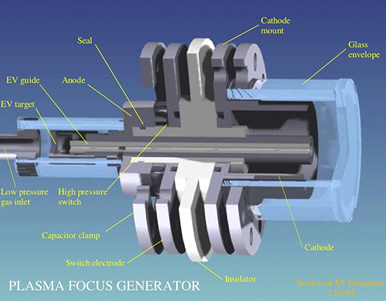 vacuum, draw in
gravitons, and convert them into
mechanical energy. Unfortunately,
however, the person responsible
for this feat was recognized as
someone who frequently makes a
mockery of expectations... vacuum, draw in
gravitons, and convert them into
mechanical energy. Unfortunately,
however, the person responsible
for this feat was recognized as
someone who frequently makes a
mockery of expectations...
Similarly,
Saboris’s Papp motor (v) operates
purely on the basis of graviton
pressure, without relying on the
polarization of a reverse current
in an electronic circuit or the
capture of magnetic overunity in a
mechanical loop: the noble gases
induce a mechanical torque in the
gravitons via the electrical
discharge in an electromagnetic
field. The graviton density
explodes, so to speak, likely
because the energy of the noble
gas atoms increases to such an
extent that the neutron feels
compelled to draw in
reinforcements from spacetime.
This triggers a reaction from the
graviton pressure, which is then
proportionally too low and serves
to amplify the electromagnetic
field. The extra supply of that
energy is then dissipated in the
conventional manner via a standard
piston engine system into
mechanical energy and heat: the
noble gas charges and discharges
itself and is scarcely consumed. It primarily acts
as a catalyst for space energy.
Another effect that may play a
role here is the so-called
Electrum Validum, or High Density
Charge Clusters (HDCC), consisting
of groups of condensed electrons
that can be experimentally
generated by discharging a high
voltage of direct current using
the Casimir effect via a so-called
cold plasma - a special gas - from
a tip in a magnetic field using a
very short pulse. When these
clusters - initially called EVs
(electromagnetic vortices) and
later renamed EVOs (exotic vacuum
objects) - coalesce into rings of
20 or 50 microns and strike an
object, they release energy that
exceeds the input by up to 91
times. The thermal process, which
does not emit any neutron
radiation, thus draws energy from
space. The rings of electrons -
whose existence contradicts
existing physical theories that
cannot conceive of a grouping of
electrons that normally repel each
other - actually form a kind of
materially observable valve for
space pressure, which then leads
to a thermal conversion of the
gravitons. The effect, which
essentially represents a packet of
electrical charge in a visible
form, was discovered in 1980 by
experimental physicist Kenneth R.
Shoulders of Bodega, California,
who, cleverly circumventing a
looming government cover-up,
obtained a patent for it in 1991
(U.S. 5,018,180.0). Secrecy was
almost imposed due to the fact
that, in principle, this
technology can be used to create
radiation weapons that do not need
to be reloaded and that
disintegrate all matter they
strike. He also received a similar
patent in 1992 (U.S. 5,153,901),
and in 1999 (U.S. 6,271,614) he
was granted a patent for a
so-called electromagnetic
plasma-drive generator that he
developed. Inventor Christopher
Arnold also refers to electron
clusters and the Electrum Validum
in the description of his 2001
super-efficient plasma fusion
motor generator, which runs on
neodymium magnets (not discussed
above, U.S. 6271614) - a concept
to which Bedini and Sprain also
refer.
Presumably, these same electron
clusters played a role not only in
the Magnatron cold fusion
precursor developed by Rory
Johnson, but also in many other
discoveries we discussed. With EVO
technology, Shoulders argued in
2007, it is in principle possible
to create space propulsion and a
defensive shield using the same
technology, though the latter
requires considerably more effort
than producing the weapon. Truly
Star Wars, then. May the force be
with you, for even a
world-destroying Star Wars EVO
sword can be manufactured this
way. Shoulders further developed
the process with his son Steve.
The discovery, which researcher
Hal Fox claims should be
considered the greatest of the
20th century, marks a milestone in
the formal recognition of the
possibility of converting space
energy into usable electrical
energy. Together with Fleishman
and Pons of cold fusion, he should
receive the Nobel Prize, according
to Fox. Ken Shoulders also
mentioned a connection between
EVOs and the Hutchison effect at
the MIT conference on Cold Fusion
technology in 2005. In addition, the
Russians Alexander Ilyanok from
Belarus, and Mesyats and
Baraboshkin from Yekaterinburg,
conducted further research to
advance this “charge cluster”
technology, and Stan Gleeson from
Cincinnati, Ohio, together with
Dr. Shang Xian Jin, discovered
that the process also works in
water and can effectively reduce
radioactivity. With these
alternative possibilities for
developing applications, HDCCs are
also coming into focus in
explaining the water processes in
the free energy sphere (literatuure, artiles pages 1, 2, 3, 4).
|
HDT-elementen
|
mass
|
charge
|
spin
|
intensity
|
time
|
spacetime
|
infinite
|
infinite
|
none
|
infinite
|
+
linear
|
|
universal
ether
|
0
|
0
|
half
|
hyper
|
cyclic
|
|
graviton
|
0
|
±
|
double
|
normal
|
cyclic
|
|
integron
|
nihil
|
0
|
none
|
geen
|
-
linear
|
|
neutron
|
1 +
nihil
|
0
|
half
|
geen
|
+
linear
|
|
proton
|
1-
nihil
|
+
|
half
|
super
|
cyclic
|
|
electron
|
nihil
|
-
|
half
|
super
|
cyclic
|
The key
players in the HDT and their
presumed properties:
the graviton is the guest player,
and the local ether is recognized
in quantum mechanics as the
integron..
In the electrolysis methods
developed by Kanarev, Stanley Meyer,
and Bill Williams (ix), water is
electrically charged; this charge,
in accordance with the polarity of
the electrolysi - specifically
through a “catastrophic dielectric
breakdown” of the accumulated charg
- yields additional energy by
altering the energetic basis of the
integron within the individual water
molecule. Due to the “energetic
strain” specific to a water
molecule, that integron must process
an additional influx of gravitons;
the energy of the water molecule
increases, but the dominant neutron
that counterbalances the integron is
not pleased with this - that neutron
must compensate by drawing from
spacetime for additional support,
and that extra energy causes the
water molecule to fall apart - after
all, there is extra integron and
neutron energy for that - and also
creates a residual potential in the
water that, like a chain reaction,
continues to run its course for
quite some time before the proper
neutron/integron equilibrium
corresponding to the water’s
vibrational frequency is restored. '"The
volts of voltage are converted
into amps of current, causing the
water to break down into hydrogen
and oxygen," as Dr. Peter
Lindeman Meyer’s work explains.
Charged water can ignite because,
with the residual production of
hydrogen and oxygen, the combustion
process can, as it were, draw the
charge out. If the charge escapes
somewhere in that water, the rest of
the charge tries to fill the gap to
distribute the charge evenly, and
this continues until the charge is
too low to release flammable Brown’s
gas. Once burned out, the water
returns to normal. When charged, it
is more or less graviton water -
water with an energy level too high
for the normal vibrational frequency
of water - which you could also call
unstable water, water that is on the
verge of exploding. Even though the
charge was built up by electricity,
it is therefore not an electrical
discharge but a gravitational
discharge that occurs gradually as
the "agitated" water slowly
"relaxes" again.
This effect of
water with an incorrect vibration
frequency that yields energy upon
dissociation is reminiscent of the
Keely effect - the influence of
sound vibrations on the vibration
frequency of various types of matter
(ii) - and the Hutchison
effect (xi), which achieves
the same result through a different
mechanism. It was already known that
cows and plants perform better when
exposed to classical music than to
pop music. The interference of
different vibrations results in a
corresponding charging of the
matter, which then is no longer
“itself,” thereby affecting the
integron value and space-time ratio
of the matter, so that a way out is
sought or a place that better suits
the new vibrational frequency. Every
planet has its own vibrational
frequency related to the planet’s
circumference. Scientifically, this
has been called the Schumann
frequency since 1952; it is an ultra-low frequency
(ULF) that varies for Earth between
7.8 Hz (standard) and 33.8 Hz, with
59.9 Hz as an overtone. It consists of the
resonance number of, for example,
lightning flashes in the cavity
formed between the Earth’s surface
and the ionosphere. This means that
the light from a lightning flash
circles the Earth 7.83 times in one
second, and thus the Earth provides
that number as its fundamental
resonance frequency. A higher
vibration number would therefore
correspond to a smaller planet if
the speed of light elsewhere were
equal to that of this solar system
or galaxy. But we have already seen
that the speed of light must be a
relative constant related to the
distance from the center of the
galaxy in question. Thus, you can
have roughly the same vibration
number with a planet very different
from ours, or the same planet in a
different galaxy with different
light-speed ratios. So be careful
with alternative electromagnetic
frequencies and the time scales
associated with them. World culture is
thus also warned against adhering to
a temporal rhythm that is foreign to
that of the Earth. This gives rise
to a psychology of a “shifted” sense
of time. According to the formula
Pt=Tw-TK, the psychological
instability of the experience of
time is found to be the result of
the tension arising from the
difference between clock time and
the time of nature (Meijer 1992).
Scientifically speaking, clocks and
calendars must align with the
frequency of the passing sun and
moon in order to be collectively and
unambiguously attuned to the
material reality and laws of that
planet. Our grasp of reality and our
mental health are determined by
this. A different vibrational
frequency thus corresponds to
another planet or a parallel world
in another galaxy with a neighboring
frequency. Thus, there would be a
whole range of parallel worlds to
which one could be transported in
phases (psychic, emotional,
material) by manipulating
electromagnetic fields or simply by
maintaining the standard time
frequencies of civil time
conditioning. It could very well
lure the aliens into creating "crop
circles" here in our cornfields. The
process of gaining energy until one
teleports seems to proceed as
follows: first, an energetic effect
arises due to the deviation from the
standard gravity of your location in
the universe, then antigravity
arises due to the loss of integron
pressure, and subsequently,
teleportation occurs via hyperspace
to the neighboring frequency of
another planet of a similar size as
the entire integrity of vibration
“jumps” or “slides” to a different
vibrational number of curved space.
In fact, this shifting is a
phenomenon that has been observed
in, among other things, NASA’s
so-called “tether incident,” during
which heavy UFO traffic was detected
in the upper atmosphere using
infrared technology. ultra-low frequency
(ULF) that varies for Earth between
7.8 Hz (standard) and 33.8 Hz, with
59.9 Hz as an overtone. It consists of the
resonance number of, for example,
lightning flashes in the cavity
formed between the Earth’s surface
and the ionosphere. This means that
the light from a lightning flash
circles the Earth 7.83 times in one
second, and thus the Earth provides
that number as its fundamental
resonance frequency. A higher
vibration number would therefore
correspond to a smaller planet if
the speed of light elsewhere were
equal to that of this solar system
or galaxy. But we have already seen
that the speed of light must be a
relative constant related to the
distance from the center of the
galaxy in question. Thus, you can
have roughly the same vibration
number with a planet very different
from ours, or the same planet in a
different galaxy with different
light-speed ratios. So be careful
with alternative electromagnetic
frequencies and the time scales
associated with them. World culture is
thus also warned against adhering to
a temporal rhythm that is foreign to
that of the Earth. This gives rise
to a psychology of a “shifted” sense
of time. According to the formula
Pt=Tw-TK, the psychological
instability of the experience of
time is found to be the result of
the tension arising from the
difference between clock time and
the time of nature (Meijer 1992).
Scientifically speaking, clocks and
calendars must align with the
frequency of the passing sun and
moon in order to be collectively and
unambiguously attuned to the
material reality and laws of that
planet. Our grasp of reality and our
mental health are determined by
this. A different vibrational
frequency thus corresponds to
another planet or a parallel world
in another galaxy with a neighboring
frequency. Thus, there would be a
whole range of parallel worlds to
which one could be transported in
phases (psychic, emotional,
material) by manipulating
electromagnetic fields or simply by
maintaining the standard time
frequencies of civil time
conditioning. It could very well
lure the aliens into creating "crop
circles" here in our cornfields. The
process of gaining energy until one
teleports seems to proceed as
follows: first, an energetic effect
arises due to the deviation from the
standard gravity of your location in
the universe, then antigravity
arises due to the loss of integron
pressure, and subsequently,
teleportation occurs via hyperspace
to the neighboring frequency of
another planet of a similar size as
the entire integrity of vibration
“jumps” or “slides” to a different
vibrational number of curved space.
In fact, this shifting is a
phenomenon that has been observed
in, among other things, NASA’s
so-called “tether incident,” during
which heavy UFO traffic was detected
in the upper atmosphere using
infrared technology.
Searl and Sweet (xii)
both reported that their generator -
which consist of rotating magnets
arranged in parallel (Searl) or
rapidly vibrating magnets (Sweet),
respectivel - first produced energy
and then generated antigravity.
Huchison, too, based on interfering
electromagnetic frequencies in a
test area, observes antigravity
arising - just like Sweet (xii)
- when the integron charge of his
objects achieves independence by
drawing in gravitons, thereby
“charging” the matter with a
different, non-material frequency.
In this context, one should also
recall the catastrophic consequences
of the so-called Philadelphia
Experiment (Project Rainbow)
conducted by the U.S. Navy in 1943,
undertaken
as an alternative to the Manhattan
Project to win the war. It is said that,
with the secret cooperation of Tesla
and Einstein, an attempt was made to
render a warship named the U.S.S.
Eldridge (photo 0) invisible by
generating strong electromagnetic
fields around the ship. It turned
into a mess because the magnetic
fields did not rotate, making it
impossible to form a boundary for
the field with the increased
electromagnetic energy. They
achieved dislocation
(teleportation), disappearance, and
reappearance, as well as the fusion
of heterogeneous materials, as
Huchison also observed: crew members
fused with the ship’s metal, others
went mad or spontaneously dissolved
into thin air or burst into flames
in the aftermath. They could not
control the phenomenon and hushed up
the project due to the disastrous
consequences. That was then, but to
this day, it appears they are still
secretly working on it in a
classified project called the
Montauk Project, which, kept well
under wraps, is a source of many
conspiracy theories regarding UFO
technology and mind-control devices
as military weapons. It should be clear
that experimenting with magnetic
fields may provide a source of
energy, but that it can also pose a
danger if it undermines the
electroma gnetic foundation of
our own physical existence, which is
protected by the integron. By
generating an artificial
gravitational field, one distorts
spacetime just as every celestial
body does, as Einstein explained
regarding the curved space of the
integron. However, this distortion
does not apply to linear time, which
is maintained by the self-generated
field that also preserves the
elementary structure of the matter
within it, consisting of protons,
electrons, and neutrons. The mere
vibration of magnetic fields can
yield extra energy, but it can also
result in a serious integrity crisis
in the fusion of heterogeneous
materials if the linear orde - the
integrity of matte - is not
maintained by the linear vibration.
The paradox of the hyperspace jump
consists in the fact that the cyclic
action of magnetic fields creates
the linear independence of the
integron. gnetic foundation of
our own physical existence, which is
protected by the integron. By
generating an artificial
gravitational field, one distorts
spacetime just as every celestial
body does, as Einstein explained
regarding the curved space of the
integron. However, this distortion
does not apply to linear time, which
is maintained by the self-generated
field that also preserves the
elementary structure of the matter
within it, consisting of protons,
electrons, and neutrons. The mere
vibration of magnetic fields can
yield extra energy, but it can also
result in a serious integrity crisis
in the fusion of heterogeneous
materials if the linear orde - the
integrity of matte - is not
maintained by the linear vibration.
The paradox of the hyperspace jump
consists in the fact that the cyclic
action of magnetic fields creates
the linear independence of the
integron.
Mechanical action of
water (vapor) also attracts
gravitons, as demonstrated by
Kelvin’s water dropper, Baumann’s
Testatika (viii), and the
hydrosonic pump developed by Griggs
and his predecessors. (x) As
we have already seen in cold fusion
and Kanarev’s processes, the atomic
structure of (heavy) water lends
itself very well to storing the
added energy that, in the various
forms of discharge, polarizes the
graviton flow attracted by the
movement of the water. In relation
to an electrostatic voltage, they
polarize into usable electrical
energy in Bouwmann’s system. They
can be converted into overunity
heat, as in Griggs’s system, or
induced into a dynamic electrical
discharge, as in Kelvin’s system.
The Testatika uses its sensors to
capture the oppositely acting stream
of polarizing gravitons via the
electrostatic charge, which is
generated mechanically, so that the
machine becomes a self-runner with
overunity. Kelvin realizes that
difference between the start and end
of the falling water’s trajectory,
much like a lightning bolt does, and
Griggs obtains his overunity heat
through the explosion of the bubbles
created by the cavities in the
rotor.
With their machines,
inventors do not immediately
overcome gravity or the generator’s
location in the universal ether
unless the magnetic fields rotate at
super- or hyper-high speeds. First
and foremost, energy is extracted
from the vacuum through the dynamic
interaction of gravitons with the
moving magnets. Only the Searl
effect exhibits antigravity through
super-rotation. The two exception -
formed by Sweet’s frequency
influence with his generator and by
Huchison in his antigravity
experiment - are, because neither is
based on rotation, less preferable
according to the HDT. Without
rotation, no integron is created for
the object but is merely vibrated
away; the generated graviton flux
then displaces the integron, which
can have disastrous effects on the
integrity of the user’s
electromagnetic matter. It could
even constitute a disintegration
weapon.
To summarize what
has been discussed so far regarding
ether machines, energy is generated
by converting natural graviton
pressure: E + Egd = ouE. In other
words: a base energy (E) capable of
attracting gravitons yields
overunity energy (ouE) upon
conversion of the gravitons that
naturally flow in due to the
integron-graviton pressure of
gravity (Egd). Put another way: the
pressure of linear time (Egd) yields
overunity energy (ouE) if, after
startup, the basic energy maintained
by the system manages to attract
gravitons through a cyclic process.
The appropriate method for
attracting the gravitons is the
rotation of magnetic fields, air, or
liquids. Linear systems that are
destructive to the integro - i.e.,
that do not build up and reinte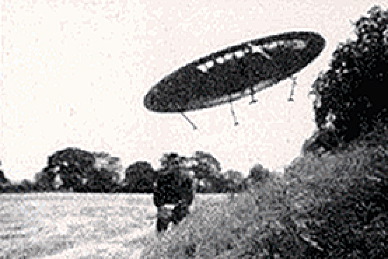 grate the integron,
or form their own gravitational fiel
- cause problems when scaled up,
even though they may be useful on a
small scale for private use. The
ether machines are graviton pumps
that convert linear time into cyclic
time. This cyclic time can generate
electrical or mechanical energy, but
in more advanced applications it can
directly produce matter. Cloning or
reproducing existing matte - as a
kind of acceleration of the natural
expansion of matter - is possible in
the HDT. The natural local
electrical behavior of Huchison’s
crystals also falls under this
definition. Due to the ordered
structure of the crystals, the
gravitons arrange themselves in such
a way that, when the crystal is
charged with an electrical impulse,
they produce an ordered graviton
uncertainty. The uncertain crystal
then seeks to regain its former
certainty via an electrical
potential arising from its order.
Depending on its structure, the
crystal may be able to maintain that
uncertainty for a long or short
time, much like how one substance
magnetizes better than another (x).
Increasing the surface area by
grinding the crystal yields more
potential. This is what Huchison
demonstrates in his Crystal Energy
Cell demonstration. Radiant
energy, such as that described by
Tesla, Moray, and the rod effect (iv)
is nothing other than the direct
tapping, via metal plates or
combinations of metals in a diode,
of the potential difference between
the linear ether of spacetime (the
“neutrinos,” etc.) and the cyclic
graviton flux of the cyclic ether or
curved space - that is, the Earth’s
magnetism. In the latter case, the
Earth is the rotating magnet, and
separate rotating mechanisms are
unnecessary. The Earth, so to speak,
already pumps all its own gravitons.
Such machines are relatively the
simplest in principle; they best
approximate the definition of the
ether machine as a valve, lock, or
gate for space energy. We do get
energy from that, but no spaceships.
Long
live spaceship Earth. grate the integron,
or form their own gravitational fiel
- cause problems when scaled up,
even though they may be useful on a
small scale for private use. The
ether machines are graviton pumps
that convert linear time into cyclic
time. This cyclic time can generate
electrical or mechanical energy, but
in more advanced applications it can
directly produce matter. Cloning or
reproducing existing matte - as a
kind of acceleration of the natural
expansion of matter - is possible in
the HDT. The natural local
electrical behavior of Huchison’s
crystals also falls under this
definition. Due to the ordered
structure of the crystals, the
gravitons arrange themselves in such
a way that, when the crystal is
charged with an electrical impulse,
they produce an ordered graviton
uncertainty. The uncertain crystal
then seeks to regain its former
certainty via an electrical
potential arising from its order.
Depending on its structure, the
crystal may be able to maintain that
uncertainty for a long or short
time, much like how one substance
magnetizes better than another (x).
Increasing the surface area by
grinding the crystal yields more
potential. This is what Huchison
demonstrates in his Crystal Energy
Cell demonstration. Radiant
energy, such as that described by
Tesla, Moray, and the rod effect (iv)
is nothing other than the direct
tapping, via metal plates or
combinations of metals in a diode,
of the potential difference between
the linear ether of spacetime (the
“neutrinos,” etc.) and the cyclic
graviton flux of the cyclic ether or
curved space - that is, the Earth’s
magnetism. In the latter case, the
Earth is the rotating magnet, and
separate rotating mechanisms are
unnecessary. The Earth, so to speak,
already pumps all its own gravitons.
Such machines are relatively the
simplest in principle; they best
approximate the definition of the
ether machine as a valve, lock, or
gate for space energy. We do get
energy from that, but no spaceships.
Long
live spaceship Earth.
What
remains is to explain Reich’s orgone
 energy (iii).
This is somewhat more complicated
because antimatter - or the
phenomenon of biological life -
plays a role here. Reich observed a
temperature difference of 0.3–1
degree Celsius at most between
organic and inorganic matter, as
well as an energetic, orgonal effect
associated with long metal tubes
interconnected at the base in a
so-called cloudbuster. Despite
Einstein’s objections, we give Reich
the benefit of the doubt here,
assuming that Einstein, in the
absence of a theory of everything
(our HDT), may have been constrained
by the prevailing horizontal
thinking to which his established
status bound him. Reich called his
energy orgonal because organic
molecules attract the etheric energy
more than inorganic molecules. In
other words, according to Reich, the
organic self functions as a graviton
pump. Organic matter possesses a
holistic integrity: while it is
still alive, it has self-awareness
and, consequently, free will -
qualities that inorganic matter
lacks. Organic matter can thus
ascend vertically in consciousness
through its own will to achieve
union, whereas inorganic matter is
incapable of such a thing. Organic
matter thus has a spiritual
counterpart; that is, spirit,
intelligence, laterality, ego,
feeling, and self-awareness
according to the HDT. Inorganic
matter does indeed have a graviton
relationship - that is,
electromagnetic properties and an
associated force field - but is
unaware of a spiritual counterpart.
Inorganic matter is impersonal;
being lifeless, it is unaware of a
parallel organization in antimatter.
Antimatter gives matter cohesion,
integrity, self-control, and a
motive for self-preservation. Matter
exhibits diversification in a
process we call evolution. Having
evolved on the material plane, the
next step consists of the return to
singularity via the path of
antimatter. In that evolution,
gender, intelligence, and spirit
arise, from which the rest of what
the HDT describes follows in the
levels above. energy (iii).
This is somewhat more complicated
because antimatter - or the
phenomenon of biological life -
plays a role here. Reich observed a
temperature difference of 0.3–1
degree Celsius at most between
organic and inorganic matter, as
well as an energetic, orgonal effect
associated with long metal tubes
interconnected at the base in a
so-called cloudbuster. Despite
Einstein’s objections, we give Reich
the benefit of the doubt here,
assuming that Einstein, in the
absence of a theory of everything
(our HDT), may have been constrained
by the prevailing horizontal
thinking to which his established
status bound him. Reich called his
energy orgonal because organic
molecules attract the etheric energy
more than inorganic molecules. In
other words, according to Reich, the
organic self functions as a graviton
pump. Organic matter possesses a
holistic integrity: while it is
still alive, it has self-awareness
and, consequently, free will -
qualities that inorganic matter
lacks. Organic matter can thus
ascend vertically in consciousness
through its own will to achieve
union, whereas inorganic matter is
incapable of such a thing. Organic
matter thus has a spiritual
counterpart; that is, spirit,
intelligence, laterality, ego,
feeling, and self-awareness
according to the HDT. Inorganic
matter does indeed have a graviton
relationship - that is,
electromagnetic properties and an
associated force field - but is
unaware of a spiritual counterpart.
Inorganic matter is impersonal;
being lifeless, it is unaware of a
parallel organization in antimatter.
Antimatter gives matter cohesion,
integrity, self-control, and a
motive for self-preservation. Matter
exhibits diversification in a
process we call evolution. Having
evolved on the material plane, the
next step consists of the return to
singularity via the path of
antimatter. In that evolution,
gender, intelligence, and spirit
arise, from which the rest of what
the HDT describes follows in the
levels above.
In this
way, living beings developed
self-awareness and control. There
is, as it were, a cycle of
differentiating energy on the
material plane that flows into
unifying energy, which moves away
from diversity or returns to the
unity of the singular on the
antimaterial or spiritual plane.
Spiritual evolution takes over from
material evolution. According to the
HDT, Charles
Darwin (1809–1882) is not
wrong, but he merely describes the
material diversification process of
organisms, not their process of
realization in which they seek and
find their original unity in the
past. We arise from a primordial
substance, but we also return to it.
These are evolutionary ideas that
can be found in the views of
pre-Socratic natural philosophers
such as Democritus
(460–370–80 BCE), in the work of the
German Romantic philosopher and
“transcendental idealist” Friedrich
von Schelling (1775–1854), and
in the writings of the French
theologian and paleontologist Pierre
Teilhard de Chardin
(1881–1955). Through this
intelligence of seeking symmetry
with the material world without
losing the diversity of matter - a
phenomenon one might call the
organic law - organisms establish
their raison d’être by mastering
matter, and evolution, which thus
enters a new phase with the
individual, achieves perfection. In
that perfection, the living being
forms an inner-outer boundary, a
dipole of unity or timelessness that
stands in contrast to diversity or
temporality, a dipole that has
existed at a fundamental level since
the beginning of creation.
Self-awareness is found in a process
of realization; it is not
conditioned from the outside as an
addition to matter. There is,
therefore, indeed an “intelligent
design” of a manifesting spiritual
antimatter structure according to
the HDT. Such a design is also
illustrated by the phenomenon of
different humanoids on different
planets, as confirmed by the
Disclosure Group. What the British
biologist Rupert Sheldrake
calls morphic
resonance is then seen as an
indication of the presence of an
intelligent cosmic “design,” a form
that has evolved elsewhere and
serves as a model for the ideal
organic form: the humanoid form, a
form toward which a turtle, a
spider, a monkey, or any organic
life form on another planet can
evolve with the same evolutionary
right (Ninja Turtles for real!). The
Swiss best-selling author Von
Däniken, with his thesis that
the gods were cosmonauts who perhaps
gave our species a less morphic
form, may very well be right about
this as well. Why shouldn’t the law
of nature apply that states that the
higher-evolved form is dominant over
the lower species, extending even to
the phenomenon of higher and lower
humanoids? The human form may be
superior, but that does not mean
that Homo sapiens is the superior
humanoid, the god of mankind (though
that may well be the case, of
course; after all, we don’t need a
flying saucer to get to paradise,
where we already are).
The
contrast between matter and
antimatter was the first in
creation. In the beginning, there
was the singularity, in which
everything was one. Then there was
pure energy - the dark matter we
call spacetime alowing with its
consciousness as the first
antimatter counterpart. Then linear
time split in terms of direction,
and universal space was created,
whereby the ego detached itself from
the bliss of self-awareness, from
the bliss of the whole. Only then
did the cyclical matter of
manifestation emerge, like
condensing water droplets, through
the swirling of time energy that
split in two because it could not
find balance. Broken symmetry lies
at the basis of creation, as
established natural science posits
today, as we have already seen. That
matter combined into organisms that
manifested the simultaneously
developed diversity of spiritual,
timeless antimatter. Only with the
cyclical manifestation of matter do
forces come into play that act upon
that matter. Simply put, after the
One came first dark energy, then the
flow of time, and only then a
material interplay of forces:
energy, time, and force -
that is, the
pradhâna, akasha, and shakti
of the three Vishnus, the primordial
ether, the universal ether, and the
local ether, as we have already
discussed. Spiritually, parallel to
this, there is self-awareness from
the One itself, then the ego, and
then the sexual opposition with a
mind and an intelligence; self-awareness,
ego, wisdom (compare:
the
natural dispositions in the Game
of Order). Only in the
evolution of the organism does the
orgone energy manifest, which is the
result of the innate tendency toward
unification, the desire to return to
the singular or to the God
ever-present in the background, as
one has come to call the integrity
of the Perfect Whole. After all, spiritual
union releases energy - the energy
that was trapped within conditioning
- just as happens physically when
hydrogen and oxygen are burned to
produce water.
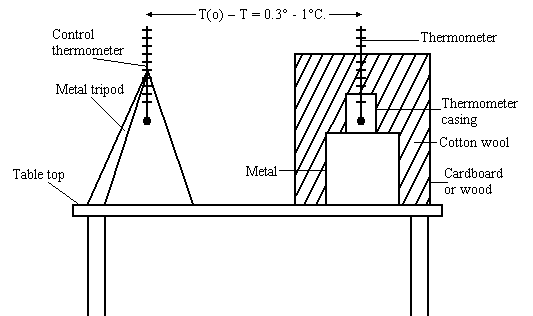
A
schematic representation of
Reich's orgone accumulator
As the Vedic classics
state: vapor or air gives rise to
fire, and fire gives rise to water.
Similarly, the reversal of evolution
in the devolution of antimatter
generates heat that arises
internally where the union takes
place. The energy of evolutionary
pressure must go somewhere and thus
generates heat. Thus, organisms are
warm in the biochemical union of
their ethereal, organically bounded
water, and their organic matter
retains that heat capacity for a
very long time even after life has
already departed. Everyone knows
that a wool sweater is “warmer” and
“breathes better” than a synthetic
sweater. But can we technically
explain this sensation using the
horizontal logic of non-hierarchical
thinking according to the old
scientific model? Now we must be
honest and not arrogantly put
forward the validity of horizontal
thinking as proof of the invalidity
of vertical HDT thinking. The heat
effect, which is indeed present in
the orgonal experimental setup shown
in the figure above, can be
explained by the antimaterial,
hierarchical devolution that, in
principle, generates heat within the
union. How this can occur with wool
and cotton from an organism that is
already dead can be explained as a
graviton charge with which the
antimatter in the living being
maintained equilibrium, and which,
in principle, can disappear over
time. Thus, fresh wool can produce a
greater temperature difference than
old wool. This must be investigated
experimentally.
There is such a thing as
spontaneous human combustion, which
shows that control over the
organic/etheric heat process can be
lost. We don’t know exactly how.
Meditating monks are an example of
successful organic heat control.
Some monks in the Himalayas can
meditate naked in freezing
temperatures so that the snow around
them melts. They generate pure heat
because they can produce gravitons
through their spiritual union. They
do not become thinner than usual,
but they do lose some of their
ability to act. The life energy must
go somewhere. Matter alone cannot
achieve this because it is, after
all, under the evolutionary pressure
of the diversification process in
which forces keep each other apart.
In devolution, however, the soul
commands an end to the
diversification, which is then
called karma or result-oriented
activity. In this union, the heat is
called spiritual happiness and love. That is what we
experience when we celebrate
Sundays: no more karma, but union
without any fruit-bearing
activities. Then there is the love
and warmth of being together, which desires nothing else but that. The
standard principles of
thermodynamics in physics pertain to
the horizontal processes of energy
binding and dissociation. Vertical
hierarchical evolution or devolution
of energetic phenomena in matter
fall outside that perspective.
Vertically, materialization and
dematerialization are normal
occurrences. Such is the nature of
evolution and its counterpart. We
come from somewhere and return to
somewhere else. In the vertical
dimension, energy binds itself
evolutionarily, step by step, into
the diversity of matter, while in
the antimatter union, that energy is
released as a binding agent of love
and happiness for the ego that must
attain self-awareness. Thus, we
arrive at a perfectly logical
conclusion by positing the graviton
- with its universal force field, or
rather, its spacetime reality or
spatial scope - as the material
counterpart of the ego with its
bliss of sexual union. It is
important to remember in this
context that space can be viewed as
a form of matter and vice versa,
just as time and matter can be seen
as transformations of one another.
Time, space, and matter define each
other as the basic elements of
visible reality: matter is
time-energy that occupies a certain
space.
desires nothing else but that. The
standard principles of
thermodynamics in physics pertain to
the horizontal processes of energy
binding and dissociation. Vertical
hierarchical evolution or devolution
of energetic phenomena in matter
fall outside that perspective.
Vertically, materialization and
dematerialization are normal
occurrences. Such is the nature of
evolution and its counterpart. We
come from somewhere and return to
somewhere else. In the vertical
dimension, energy binds itself
evolutionarily, step by step, into
the diversity of matter, while in
the antimatter union, that energy is
released as a binding agent of love
and happiness for the ego that must
attain self-awareness. Thus, we
arrive at a perfectly logical
conclusion by positing the graviton
- with its universal force field, or
rather, its spacetime reality or
spatial scope - as the material
counterpart of the ego with its
bliss of sexual union. It is
important to remember in this
context that space can be viewed as
a form of matter and vice versa,
just as time and matter can be seen
as transformations of one another.
Time, space, and matter define each
other as the basic elements of
visible reality: matter is
time-energy that occupies a certain
space.
Some scientists
refer to religion and meditation as
a regressive process, but
“regression” is not the right word.
“Devolution” is the correct term. In
English, it refers to the delegation
of central government functions to
regional authorities, but here we
wish to use this term to describe a
natural process of inner unification
while preserving external diversity
and structure. In a horizontal view,
regression suggests the
disintegration of the structure of
matter toward a previous stage. But
devolution merely reverses the
course of evolution inward, without
losing diversity: there is then
vertical “decline” in the sense of
not achieving further results.
Energy is directed toward happiness
and self-awareness, toward the
stability of marriage and the
harmony of the mind and
intelligence. Rituals then serve to
maintain contact with reality and to
dissipate excess energy in order to
prevent “self-ignition” or unwanted
self-heating. Every culture of
spiritual communion has rituals and
sacrificial ceremonies. Those who
think horizontally do not understand
this and assume that someone
somewhere is profiting from the
religious charade. But most
spiritual practices can be performed
quite well on one’s own, without the
attention of others. So that
reasoning does not hold up. The
essence of the energy issue as
discussed here is that we receive
energy and find harmony from the
(relative) ether - whether through
mechanical-experimental or organic
means - in spiritual communion. We
radically reject the notion that it
is all a deception perpetrated by
people who only cost you money and
your energy - or even your
intelligence or integrity - as a
form of pathological suspicion or
jealousy, a product of a distorted
sense of time. Religions may be old
hat and the religious books full of
metaphors and allegories, but they
still form an essential basis for
the gain of ethereal energy upon
which culture thrives. The energy
issue is resolved from a
psychological perspective when we
clearly grasp the order of time as
it exists in nature. By resolving
the psychological issues associated
with flawed conditioning, we
naturally face the next practical
step in our cultural evolution:
replacing internal combustion
engines with quantum mechanical
vacuum or space-energy converters -
or ether machines - that operate
based on an experiment confirming
the relative ether as an energy
source. We must carry out that
experiment so that all this theory
and the accompanying speculations
and hypotheses lead to replicable
machines - in other words, so that
it works - and is thus, at least in
part, valid in its fundamentals.
Until then, we will have to make do
with solar energy as the form of
renewable energy that comes closest
to the direct extraction (or
conversion) of relative space
energy.
So if we want to
understand what Reich was doing, we
must consider the vertical line of
thought. He clearly saw a connection
between orgone energy and sexuality.
He hypothesized that exposing a
person to orgone energy in one of
his accumulators would cure the
person of impotence and similar
conditions. Sexual union, practiced
in a tantric manner - that is,
meditatively, non-violently, and not
focused on a result - constitutes
one of the two gateways in HDT - the
so-called Dionysian or hedonistic
path - that makes spiritual union
possible. The other path is that of
spiritual union through the
intellect: the Apollonian path. In
this context, one also speaks of
left-handed and right-handed tantra
yoga. And these two choices are
available to beginners. As soon as
the ego arises, it is over,
according to the HDT. If you
meditate on sex, the intellect
unites with the spirit to form the
ego. Equally, you may also notice
that with intellectual work not
focused on results, a celibate path
can be taken: sex can become a
disruptive factor because it
distracts too much from the
“higher.”
The ego, or sense of self, that
arises from spiritual union stands
in contrast to the happiness sought
in sexual union. According to the
HDT, it is an inevitable side effect
resulting from the duality of the
whole. So unless, in the next stage,
one merges the ego with happiness
without further involving sex, no
stable self-awareness can arise that
enables the control over matter
necessary for humans to exercise
their free will non-destructively
and thus continue to exist
peacefully in harmony with nature
and with one another. After sexual
meditation comes ego meditation;
after sexual happiness comes ego
happiness. Ego happiness is
self-awareness; it is the individual
soul. The material parallel to this
is that the energy gain and heat
gain from the material union on an
organic basis involves the
conversion of gravitons - or orgone,
undirected energy - on a material
basis. While such an energy gain may
contradict the principles of
thermodynamics, it does not
contradict the HDT. Orgone energy
gain is nothing more than the
reversal of the force of evolution,
a reversal in which gravitons are
recovered by giving up
diversification or the karmic
pursuit of results. Benefit:
materially, there is thermal energy
and vital harmonization, and
spiritually, there is an increase in
synergy because there is more love
and happiness, and the ego can
attain self-awareness. This aligns
with Reich’s claims that his
accumulator would cure people of
colds, cancer, and sexual ailments.
 In
summary, orgone energy production
begins with the tantra - or the
intellectual aspect - of
transcending the mind and the
sexual, and then, at higher levels
within the individual soul, involves
the unification of the ego in bliss.
Finally, the individual soul must
also seek its eternity in the more
enduring and permanent liberation
within the singular self of the
universe: the Super-soul of what the
person originally is as a union of
all matter, space, and time. From a
spiritual perspective, the HDT is in
accordance with the teachings of the
science of tantra and yoga: first,
one is pas’u-tantric, purely sexual,
to give the mind an “I”; then, one
is vira-tantric, more engaged in
yoga to give happiness a soul; and
finally, one is divya-tantric, with
pure devotion, more like a monk and
predominantly celibate, engaged in
bringing self-awareness to
God-consciousness. And thus the
timeless devolution is complete
without any regression occurring on
the material plane. In
summary, orgone energy production
begins with the tantra - or the
intellectual aspect - of
transcending the mind and the
sexual, and then, at higher levels
within the individual soul, involves
the unification of the ego in bliss.
Finally, the individual soul must
also seek its eternity in the more
enduring and permanent liberation
within the singular self of the
universe: the Super-soul of what the
person originally is as a union of
all matter, space, and time. From a
spiritual perspective, the HDT is in
accordance with the teachings of the
science of tantra and yoga: first,
one is pas’u-tantric, purely sexual,
to give the mind an “I”; then, one
is vira-tantric, more engaged in
yoga to give happiness a soul; and
finally, one is divya-tantric, with
pure devotion, more like a monk and
predominantly celibate, engaged in
bringing self-awareness to
God-consciousness. And thus the
timeless devolution is complete
without any regression occurring on
the material plane.
With this final direct
energy generator from Reich, we can
conclude that the engineer is a
self-aware human being who has not
excluded himself from the machine.
What we can learn from Reich is that
human beings themselves are the most
important generators of free energy
- the free energy we need to find
greater synergy with one another and
thus be able to solve common
problems. In Reich, we see organism
and mechanism merging, and in this
way he provides a fitting conclusion
to the energy question. It may take
another thirty or forty years before
we can buy free-energy machines in
stores. Developing technology for
the consumer simply takes a lot of
time and effort. We’ll leave his
so-called cloudbuster for
controlling the climate aside for
now as a karmic eccentricity of his.
Dispersing clouds doesn’t seem
directly relevant to the topic of
the energy issue, even though there
is a connection to the climate
problem. The plan is more about
allowing the climate to recover by
disturbing it less.
In conclusion, we can
say that the hero of our story is
the graviton particle: the
invisible, massless particle of
cyclic time-energy with its diffuse
charge and spin. According to formal
physics, within the framework of
quantum field theory, the graviton
is a hypothetical elementary
particle that mediates gravity, and
it does so via what we have called
the integron, or the linear effect
of space pressure. Since the
particle is not yet known,
scientists hope to detect it in
particle accelerators. String
theory, in fact, predicts the
existence of gravitons as well as
their clearly defined interactions.
However, HDT asserts that
manipulation of the graviton is not
possible without converting it into
another particle, just as the speed
of light cannot serve as a material
quantity to prove - or disprove -
the ether as a non-material, but
protomaterial phenomenon. You’re comparing
apples to oranges, and that doesn’t
work in the HDT; in the HDT, you
have to calculate differently at a
different level of the hierarchy of
manifestation. It is the effects
we’ve discussed here that constitute
the experimental evidence for the
graviton. The rotation or vibration
of magnetic fields generates energy,
affects gravity, and can warp
spacetime. But a bottle of gravitons
remains just a bottle containing a
vacuum. We found a nice description
of the graviton on YouTube. A young
American woman with no knowledge of
physics had a dream and talks about
it in a video titled: Random
Thoughts - What is a Graviton?. She
saw a particle shaped like a bead,
with a tree projected inside it like
a strand of DNA. She then wondered:
“God, are you telling me that the
nature of the universe is
contained in a graviton particle?”
The HDT agrees with her; the entire
universe is found within the space
formed by the graviton.
The energy
issue - including its innovations
and the HDT statement acknowledging
the reality of orgone quality, as we
have seen - is also a matter of how
we handle our personal energy: are
we focused upward on selfless,
spiritual love and inner union with
the personal and societal benefits
thereof, or are we filled with
rivalry, focused on having
biological or spiritual children who
must ensure the material continuity
of our civilization? The answer is
that Jacob’s ladder can be used both
upward and downward. It is as we saw
in *The Ether Exists!* (Aadhar
2006), we saw it more as a so-called
Escher staircase: climbing up is
simultaneously descending. That is
evolution and refinement in harmony.
And that is what it is all about.
For our progress as humanity as a
whole, the vertical HDT concept of
the relative ether is, in any case,
of essential importance if we wish
to address the issue of direct
energy harvesting and climate
control.
To explain why electrical or
mechanical energy is produced
through direct transformation, we
will have to explore this line of
thought. For if we do not know the
source of the energy, but are able
to generate energy using an
invention such as the ether machines
described above, a curious problem
arises: we have hands that, through
invention, prove to be more
intelligent than our brains can keep
up with - hands that are smarter
than brains. The child is already
here but cannot yet think. As
Bearden also confirms, we are still
very much in the early stages of
ether technology. In this context,
discussing a possible conspiracy by
established financial powers to
suppress free energy - powers that
are allegedly repressive - s less
important than understanding the
psychology of the paradigm conflict
within a single individual. Once
that psychology - which, as we have
seen, is linked to the order of time
- is understood, we achieve the
integration of the cultural person,
and suspicion loses its power, no
matter how real the threats were
that are symptomatic of the
ignorance surrounding an
evolutionarily inevitable renewal.
-

|