Renown Ego's
FOR LITERATURES: SEE VAISHNAVISM, AND THE CLASSIC EPIC THE
RAMAYANA or the RAMKATHA RASAVAHINI CH 7b This character is descibed in THE CLASSIC EPIC THE BHAGAVAD PURANA (SRIMAD
BHAGAVATAM) painting by Ingres : Romulus Conquerer of Acron BRITANNICA | BIOGRAPHY BY PLUTARCH BRITTANICA + LINKS | BECK-PAGE IN 'THE REPUBLIC' OF PLATO | BRITANNICA ON SOPHISTS BRITANNICA | IDES TO ACTIUM | ARTICLES ON ROMAN CULTURE BRITANNICA | THERE ARE TWO LETTERS OF HIM IN THE HOLY BIBLE SELECTED WRITINGS | BIOGRAPHY | BRITANNICA | GLOSSARY OF TERMS OF HIM Emperor
Sigismund: The
Holy Roman Emperor during the 100-year war in Europe. He was an
expansionist making for a United (catholic) Europe. He fought the
Hussites and only after a long struggle won the war against them at the
end of his life. He pacted with Henry V to restore christian unity and
fought the Turks. He was Holy Roman emperor from 1433, king of Hungary
from 1387, German king from 1411, king of Bohemia from 1419, and
Lombard king from 1431. He was the last emperor of the House of
Luxembourg. It were the people of Holland who resisted his attempts to
incorporate them in his unity. BRITANNICA | LINE
| BIOGRAPHY.COM BRITANNICA | WEBSITE (IN DUTCH)| DUTCH NATIONAL ANTHEM /WILHELMUS-SITE | RVD-PAGINA (DUTCH)| FACTS
| BRITANNICA | PHILOSOPHY | EPISTEMOLOGY | LINKS
| E-BOOKS
BRITANNICA | BOOK OF MORMON | MORMON : THE STANDARD WORKS WORKS & SITES | FREUDIAN LINKS | BRITANNICA + RESOURCES | FREUDNET | LONDON FREUD MUSEUM|
© the
egopages 2000
This page is projected for
displaying information about my personal idea of renown ego:
identifying with the historical personalities of these ego's I dare
say: these could have been the lives that led to the life I am living
now. This page offers a time-line through human history from a personal
point of view: the ego as a time-organizer.
 about 7000
B.C.
(or more). Sathananda: an ancient vedic priest at the time of the
Ramayana, son of guru Gautama Maharishi and his wife Ahalya. He was ,
in his younger days, criticized by Rama and Laksmana for his lack of
continence being overly enthusiastic seeing them. Ultimately he was the
one to wed Rama with Sita at the court of King Janaka and the one who
inaugurated the worship of God after the defeat of the demon Ravana.
about 7000
B.C.
(or more). Sathananda: an ancient vedic priest at the time of the
Ramayana, son of guru Gautama Maharishi and his wife Ahalya. He was ,
in his younger days, criticized by Rama and Laksmana for his lack of
continence being overly enthusiastic seeing them. Ultimately he was the
one to wed Rama with Sita at the court of King Janaka and the one who
inaugurated the worship of God after the defeat of the demon Ravana.
about 3200 b.c. Emperor Parikchit: The first emperor after the fall of the vedic culture
after the great war of the Mahabharat. This Emperor, who as a child was
protected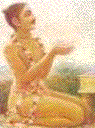 by Lord Krishna, set the norms of conduct for Kali-Yuga
(modern Time). He alotted Kali, the impersonation of the human
weaknesses of eating meat, drinking alcohol, illicit sex and gambling,
a separate place in his empire on the condition that he would not
propagate the weaknesses outside of his territory. Parikchit lost the
throne being cursed by a sages son whom he had insulted for not being
hospitable. This led to the realization of a separate spiritual society
, where he would die in a week's time receiving the teachings of Lord
Krishna from His devotees.
by Lord Krishna, set the norms of conduct for Kali-Yuga
(modern Time). He alotted Kali, the impersonation of the human
weaknesses of eating meat, drinking alcohol, illicit sex and gambling,
a separate place in his empire on the condition that he would not
propagate the weaknesses outside of his territory. Parikchit lost the
throne being cursed by a sages son whom he had insulted for not being
hospitable. This led to the realization of a separate spiritual society
, where he would die in a week's time receiving the teachings of Lord
Krishna from His devotees.
 about 750 B.C. Romulus of Rome: the founder of Rome, who
together with his twin-brother Remus according the legend was raised by
a she-wolf. They were born the sons of the God Mars and Rhea Silvia
daughter of Numitor, king of Alba Longa. After defeating the tyrant
Amulius they restored the honor of the family and built the city of
Rome at Palatine hill. He killed Remulus his brother founding Rome due
to quarrels and later offered asylum to fugitives and exiles. He
settled for the first roman calendar (of 305 days, 10 months) that was
later replaced by the Republican calendar that held till the Julian
reform. He has also been identified with the roman God Quirinus, a
tradition broken by Emperor Augustus who replaced him for Julius Caesar
as a God.
about 750 B.C. Romulus of Rome: the founder of Rome, who
together with his twin-brother Remus according the legend was raised by
a she-wolf. They were born the sons of the God Mars and Rhea Silvia
daughter of Numitor, king of Alba Longa. After defeating the tyrant
Amulius they restored the honor of the family and built the city of
Rome at Palatine hill. He killed Remulus his brother founding Rome due
to quarrels and later offered asylum to fugitives and exiles. He
settled for the first roman calendar (of 305 days, 10 months) that was
later replaced by the Republican calendar that held till the Julian
reform. He has also been identified with the roman God Quirinus, a
tradition broken by Emperor Augustus who replaced him for Julius Caesar
as a God.
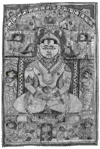 599-527 B.C. Mahavira ("Great Hero"
original name: Vardhamana): the vedic saint who ended the long line of 24
tirthankara's (Jina's -'victors'- or wise men) and founded the modern
concept of yoga as practiced by the Jains. He was renown for meditating
naked practicing the ultimate of non-violence. He attained
enlightenment (kaivalya), and propagated the 'great vow' (mahavrata) of
renunciation. The jains disapprove of the inequality of castes and
propagate the patronage of women, especially those of royal families.
They aquired support from lower caste groups by the borrowing of
rituals and practices from popular local cults.
599-527 B.C. Mahavira ("Great Hero"
original name: Vardhamana): the vedic saint who ended the long line of 24
tirthankara's (Jina's -'victors'- or wise men) and founded the modern
concept of yoga as practiced by the Jains. He was renown for meditating
naked practicing the ultimate of non-violence. He attained
enlightenment (kaivalya), and propagated the 'great vow' (mahavrata) of
renunciation. The jains disapprove of the inequality of castes and
propagate the patronage of women, especially those of royal families.
They aquired support from lower caste groups by the borrowing of
rituals and practices from popular local cults.
about 500 B.C. Trachymachus of Chalcedon: a philosopher in ancient Greece at the time
of Plato known for his scepticism. He challenged Socrates to prove that
man is innately good. He belonged to the sophists (like Protagoras and
Antiphon) who held that what is commonly called good and bad or just
and unjust does not reflect any objective fact of nature but is rather
a matter of social convention. He can be regarded an early
representative of moral skepticism and the primacy of the ego, the view
that it is rational and logical to follow one's own interests.
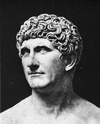 about 82
-30
B.C. Marcus Antonius: The general of Julius
Caesar who was initially denied succession after the murder of Ceasar
but was given as a co-ruler the eastern half of the roman empire
containing Egypt. He propagated a greco-roman policy that only three
centuries later was resumed by Constantine. He was in love with
Cleopatra (like Caesar was) and alienated from the roman citizens while
residing in Egypt. Rome campaigned against him (as did the earlier
Cicero against him and Caesar) led by the coldly deliberated Octavian
who was once insulted by him and had denied him the allied support in
the battles against Parthia. After him the Roman Empire was more of a
dictature in worship of Caesar and his calendar in a constant (and
corrupt) struggle for the power of rule (as Plato had predicted), than
a classical republic. He died of his own hand after being defeated by
Actium, by the same Octavian , the later Augustus who thwarted the
julian calendar to his own name (hence the month August with 31 days)
and abolished the classical roman worship of Quirinus, the God
associated with Romulus the founder of Rome who settled for the first
(lunar) version of our calendar.
about 82
-30
B.C. Marcus Antonius: The general of Julius
Caesar who was initially denied succession after the murder of Ceasar
but was given as a co-ruler the eastern half of the roman empire
containing Egypt. He propagated a greco-roman policy that only three
centuries later was resumed by Constantine. He was in love with
Cleopatra (like Caesar was) and alienated from the roman citizens while
residing in Egypt. Rome campaigned against him (as did the earlier
Cicero against him and Caesar) led by the coldly deliberated Octavian
who was once insulted by him and had denied him the allied support in
the battles against Parthia. After him the Roman Empire was more of a
dictature in worship of Caesar and his calendar in a constant (and
corrupt) struggle for the power of rule (as Plato had predicted), than
a classical republic. He died of his own hand after being defeated by
Actium, by the same Octavian , the later Augustus who thwarted the
julian calendar to his own name (hence the month August with 31 days)
and abolished the classical roman worship of Quirinus, the God
associated with Romulus the founder of Rome who settled for the first
(lunar) version of our calendar.
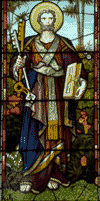 about 30 B.C- 64 AD The Apostle Peter: (orig. Simeon) A fisherman
and the first disciple of Lord Jesus. Of him He said: "that is the rock
I will built my church upon". (Cephas or. rock, hence Peter from the
latin petra for rock). He was the leader of the followers of Christ
after his crucifixion and was crucified himself later on in Rome with
his feet upward ( this on his own request out of respect for Lord
Jesus).
about 30 B.C- 64 AD The Apostle Peter: (orig. Simeon) A fisherman
and the first disciple of Lord Jesus. Of him He said: "that is the rock
I will built my church upon". (Cephas or. rock, hence Peter from the
latin petra for rock). He was the leader of the followers of Christ
after his crucifixion and was crucified himself later on in Rome with
his feet upward ( this on his own request out of respect for Lord
Jesus).
The
Middle Ages: In the Fall of Ancient and unholy Rome I could not find
any fame. I think of a traveling quack selling self-made medicines to
the people in Europe at the time or of original american Indians before
Columbus.
about 1120- 1198 A.D King Roderick O'Connor: king of Connaught and the
last high king of Ireland. He failed to turn back the Anglo-Norman
invasion that led to the conquest of Ireland by England. He was
permitted to exercise authority over territories that had not fallen
under the Norman rule. Expelled from his kingdom by members of his own
family He withdrew in a monastery. 1222-1282 A.D the monk Zennichi (Zesho-bo Rencho): An ancient buddhist monk
from Japan realized as the reincarnation of Bodhisattva Jogyo who
established socalled True Buddhism in a reaction to the many sects
buddhism was divided in. He renamed himself in "Nichiren", or
literally, "Sun Lotus". He was convinced that "only the Lotus Sutra is
the true teaching and the only Law of Buddhism that can lead all living
beings to enlightenment" and that "Zen is the work of demons" . He was
almost murdered for his reforms. His Buddhism is considered typically
Japanese in the sense that it can not be confined to mere speculation
or even to individual salvation. It is concerned with the salvation of
society and its temporal institutions thus giving importance to the
right understanding of history and human affairs. There are currently
approximately 15 million people worldwide, most of whom are members of
the Soka Gakkai lay organisation, who regularly practise the Buddhism
of Nichiren Daishonin. Many of his writings are still extant in their
original form and have now been translated into many different
languages.
1285 -1349 A.D William of Occam ("Venerable Enterpriser"
"Invincible Doctor"): the scholastic philosopher, theologian, and political
writer who left the franciscan monastery, because the Pope had ordained
that each order should take care of its own material affairs. He is
known to be the inventor of 'Occams Razor': the philosophical principle
of scientific parsimony (do not venture into the plural without
necessity). He is regarded as the founder of a form of nominalism - the
school of thought that denies that universal concepts such as "time"
have any reality apart from the individual things signified by the
universal or general term. He maintained correspondence with the
aristocracy of his time. He can also be recognized as the father of
modern rationality before Descartes.14 FEB 1367/68 - 9 DEC 1437
1452-1519 A.D Leonardo Da Vinci : the
famous artist/inventor painter, draftsman, sculptor, architect, and
engineer . His genius, perhaps more than that of any figure, epitomized
the Renaissance humanist ideal. 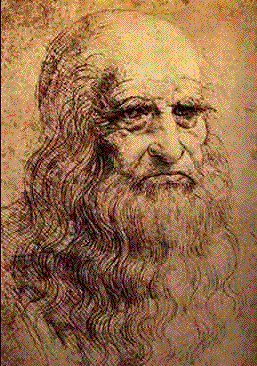 He developed his own "theory
of knowledge," unique in its kind, in which art and science form a
synthesis. He carried with a spiritual force, that generated in him an
unlimited desire for knowledge and guided his thinking and behavior. He
contributed to the mechanics of solids, military engineering, anatomy,
the authority of phenomena, autopsy development, biology, embalming
development, geochronology, the helicopter & the history of air
transportation, light propagation theory, canal locks and toolmaking.
Later in his life he got frustrated because of not being respected for
his scientific work in his own time. Only later on in history mankind
could appreciate his visionary contributions to the full. He had a
peculiarity: he wrote backwards.
He developed his own "theory
of knowledge," unique in its kind, in which art and science form a
synthesis. He carried with a spiritual force, that generated in him an
unlimited desire for knowledge and guided his thinking and behavior. He
contributed to the mechanics of solids, military engineering, anatomy,
the authority of phenomena, autopsy development, biology, embalming
development, geochronology, the helicopter & the history of air
transportation, light propagation theory, canal locks and toolmaking.
Later in his life he got frustrated because of not being respected for
his scientific work in his own time. Only later on in history mankind
could appreciate his visionary contributions to the full. He had a
peculiarity: he wrote backwards.
BRITTANICA| BIOGRAPHY | VASARI-PAGE | LIFE & WORK | GEOLOGY/PALEONTOLOGY | DRAWINGS | PAINTINGS | Nederlandse Pagina
 1544-1584 A.D William I ("The Silent"),
prince of Orange, Count of Nassau :
First of the stadholders (1572-84) in Holland. He was the dutch noble
who led the resistence of the christian reformation against catholic
Spain during the 80-year war of Holland. Passing his formative years in
Breda and Brussels he grew up french speaking with a colloquial command
of Dutch. He was one of the negotiators of the Treaty of
Cateau-Cambrésis (1559), which, in ending the prolonged strife
between Burgundy-Habsburg and France, released from French occupation
his princedom of Orange and made the Netherlands accessible to
Calvinist preachers from France. He was originally a catholic, but
sided with reformation upon the spanish repression. He was influenced
by the humanist views of Desiderius Erasmus. His whole life he tried to
pacify the christian fugues, resenting religious persecution. Although
remaining a catholic himself later he confessed to have always been a
reformist at heart. He was condemned by the pope and assassinated by a
fanatic catholic after the liberation of the Netherlands
1544-1584 A.D William I ("The Silent"),
prince of Orange, Count of Nassau :
First of the stadholders (1572-84) in Holland. He was the dutch noble
who led the resistence of the christian reformation against catholic
Spain during the 80-year war of Holland. Passing his formative years in
Breda and Brussels he grew up french speaking with a colloquial command
of Dutch. He was one of the negotiators of the Treaty of
Cateau-Cambrésis (1559), which, in ending the prolonged strife
between Burgundy-Habsburg and France, released from French occupation
his princedom of Orange and made the Netherlands accessible to
Calvinist preachers from France. He was originally a catholic, but
sided with reformation upon the spanish repression. He was influenced
by the humanist views of Desiderius Erasmus. His whole life he tried to
pacify the christian fugues, resenting religious persecution. Although
remaining a catholic himself later he confessed to have always been a
reformist at heart. He was condemned by the pope and assassinated by a
fanatic catholic after the liberation of the Netherlands
 1596-1650
A.D
René Descartes : the famous mathematician, scientist, and
philosopher . He founded the modern scientific method of systematic
doubt, division, order and completeness and can as such be considered
the father of the modern philosophy. He was known for his 'cogito ergo
sum', 'I think, therefore I am' with which he founded modern science as
a dualistic rational, and spiritual ('mind for the soul')
discipline. Metaphysically he was an intuitionist, but in his physics
and physiology he was an empiricist and even mechanicist deriving from
sensory perception. He inaugurated a critical era of philosophy by
stressing the ancient problem of the origin of ideas including the idea
of time . He resided in the Netherlands from 1629 to enjoy a greater
liberty than was available anyplace else. There he was harassed by the
calvinists for preaching religious tolerance stating that all the
Christians had the same common ground and heaven for a prospect. At the
end of his life he went to Sweden to work for Christina the queen of
Sweden, who unsettled his habits of meditation. He cought a cold an
died subsequently of a pneumonia.
1596-1650
A.D
René Descartes : the famous mathematician, scientist, and
philosopher . He founded the modern scientific method of systematic
doubt, division, order and completeness and can as such be considered
the father of the modern philosophy. He was known for his 'cogito ergo
sum', 'I think, therefore I am' with which he founded modern science as
a dualistic rational, and spiritual ('mind for the soul')
discipline. Metaphysically he was an intuitionist, but in his physics
and physiology he was an empiricist and even mechanicist deriving from
sensory perception. He inaugurated a critical era of philosophy by
stressing the ancient problem of the origin of ideas including the idea
of time . He resided in the Netherlands from 1629 to enjoy a greater
liberty than was available anyplace else. There he was harassed by the
calvinists for preaching religious tolerance stating that all the
Christians had the same common ground and heaven for a prospect. At the
end of his life he went to Sweden to work for Christina the queen of
Sweden, who unsettled his habits of meditation. He cought a cold an
died subsequently of a pneumonia.
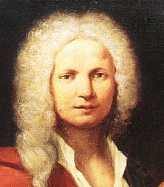 1678- 1741 A.D Antonio Vivaldi : the famous Italian baroque composer, former priest, who
traveled Europe to enlighten the nobles and the people with his sublime
culture of vital and imaginative music. He started his carreer in a
girls orphanage. His 12 concertos L'estro armonico op.3 (1711),
containing some of his finest concertos, were first issued in Amsterdam
and widely circulated in northern Europe, which made him renown. His
approach to secure a greater thematic unity had a profound influence in
musical history. From him the fast-slow-fast structure of movements
originated. Vivaldi's importance lies in his concertos, for their
central place in the history of the concerto form. Born in Venice,
Italy, he stayed some time in 1738 in Amsterdam, and he died in Vienna,
Austria.
1678- 1741 A.D Antonio Vivaldi : the famous Italian baroque composer, former priest, who
traveled Europe to enlighten the nobles and the people with his sublime
culture of vital and imaginative music. He started his carreer in a
girls orphanage. His 12 concertos L'estro armonico op.3 (1711),
containing some of his finest concertos, were first issued in Amsterdam
and widely circulated in northern Europe, which made him renown. His
approach to secure a greater thematic unity had a profound influence in
musical history. From him the fast-slow-fast structure of movements
originated. Vivaldi's importance lies in his concertos, for their
central place in the history of the concerto form. Born in Venice,
Italy, he stayed some time in 1738 in Amsterdam, and he died in Vienna,
Austria. (conc. two violins)
BIOGRAPHY | HOMEPAGE | REPUTATION | SHEETMUSIC | BRITANNICA | MIDI ARCHIVE | LINKS
|
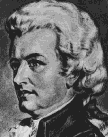 1756-1791 A.D Wolfgamg Amadeus Mozart : Born in Vienna, he was the
classical composer 'always in love' who was one of the first to
experiment for the modern tonality and grand symphonies, opera's and
concierto's. He knew Beethoven and was befriended with ' papa' Haydn.
With them he was the all-round champion of the classical Viennese
school. Hummel was a pupil of Mozart. Envied by Salieri, admired by
Goethe and supported by da Ponte he wrote the finest classical opera's.
He also traveled Europe frequenting the courts (and stayed and composed
in the Netherlands also) and was awarded by the Pope (although fired by
arch-bishop Colloredo for his adamancy). He became an independent
artist, worked too hard and died prematurely of an epidemic flew, just
before the French Revolution.(pianoconc.21 in C , kv.467a)
1756-1791 A.D Wolfgamg Amadeus Mozart : Born in Vienna, he was the
classical composer 'always in love' who was one of the first to
experiment for the modern tonality and grand symphonies, opera's and
concierto's. He knew Beethoven and was befriended with ' papa' Haydn.
With them he was the all-round champion of the classical Viennese
school. Hummel was a pupil of Mozart. Envied by Salieri, admired by
Goethe and supported by da Ponte he wrote the finest classical opera's.
He also traveled Europe frequenting the courts (and stayed and composed
in the Netherlands also) and was awarded by the Pope (although fired by
arch-bishop Colloredo for his adamancy). He became an independent
artist, worked too hard and died prematurely of an epidemic flew, just
before the French Revolution.(pianoconc.21 in C , kv.467a)
WEBPROJECT & BIOGRAPHY | COMPOSITIONS (MIDI)
| ESSAYS ABOUT HIM | PEOPLE | DIRECTORY | GUIDED TOUR | MIDI ARCHIVE , MIDI-WORLD| BRITANNICA +RESOURCES| LINKS|
MOZART LOVER'S PAGE | KOCHELS LIST OF WORKS | DATABASE
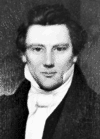 1805-1844
A.D
Joshua
Smith: The
founder of the Church of Jesus Christ of Latter-day Saints and other
Mormon denominations in America that endeavoured to make christianity
vegetarian. After having visions in seclusion he produced (received)
golden tablets with the book of Mormon. It dealt with the history of
american Indians as descendants of migrated Hebrews. In his theology he
combined elements of jewish and christian mysticism with the goal of
the good of all mankind and sought to establish his visions on
christianity as a complete way of life. He was a polygamist and died
together with his brother a martyr after conficts on his ambition to
become the president of the United States.
1805-1844
A.D
Joshua
Smith: The
founder of the Church of Jesus Christ of Latter-day Saints and other
Mormon denominations in America that endeavoured to make christianity
vegetarian. After having visions in seclusion he produced (received)
golden tablets with the book of Mormon. It dealt with the history of
american Indians as descendants of migrated Hebrews. In his theology he
combined elements of jewish and christian mysticism with the goal of
the good of all mankind and sought to establish his visions on
christianity as a complete way of life. He was a polygamist and died
together with his brother a martyr after conficts on his ambition to
become the president of the United States.
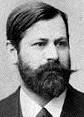 1856-1939 A.D Sigmund Freud: the doctor, psychologist,
philosopher (also called an artist), born in Vienna, who analyzed the
european hysteria of the 19th century finding cultures of repression
and decay ('the tide') that foreboded the second worldwar. He founded
the Psychoanalytic Society and was associated with Carl Jung who
departed from him in his analytical psychology that was more
spiritually oriented. Jung called Freud a neurotic himself. On a
congress Freud fainted on the realization of Jungs opposition to the
'father' that he thought to be himself. From Freud humanity realized
the existence of the unconscious, the Oudipous complex (the son jealous
with the father) and the division of Es, Ego and Superego of which he
said: 'where Es is, there will be Ego". He had a special interest in
sexual trauma, thought of religious rituals as being regressive, smoked
too much cigars and died of cancer of his palate leaving the world the
(unfinished) psychoanalytic method that together with Friedrich
Nietsche's philosophy founded the modern culture of psychotherapy and
self-realization. He died the 23 sept '39, at the onset of the second
worldwar; the 'tide' he could not turn (his 'your time is up' was his
most frequently heard interpretation).
1856-1939 A.D Sigmund Freud: the doctor, psychologist,
philosopher (also called an artist), born in Vienna, who analyzed the
european hysteria of the 19th century finding cultures of repression
and decay ('the tide') that foreboded the second worldwar. He founded
the Psychoanalytic Society and was associated with Carl Jung who
departed from him in his analytical psychology that was more
spiritually oriented. Jung called Freud a neurotic himself. On a
congress Freud fainted on the realization of Jungs opposition to the
'father' that he thought to be himself. From Freud humanity realized
the existence of the unconscious, the Oudipous complex (the son jealous
with the father) and the division of Es, Ego and Superego of which he
said: 'where Es is, there will be Ego". He had a special interest in
sexual trauma, thought of religious rituals as being regressive, smoked
too much cigars and died of cancer of his palate leaving the world the
(unfinished) psychoanalytic method that together with Friedrich
Nietsche's philosophy founded the modern culture of psychotherapy and
self-realization. He died the 23 sept '39, at the onset of the second
worldwar; the 'tide' he could not turn (his 'your time is up' was his
most frequently heard interpretation).
THE PSYCHOANALYUTIC CONNECTION | AUDIO SAMPLE: " People did not believe in my facts, and thought my
theories unsavoury, in the end I succeeded, but the struggle is not yet
over." (from TIME)
 Renatus (René means reborn) , Petrus,
Bernardus, Antonius Meijer (b. 9-23-1954 ), born a dutch Catholic, in Breda (the town
of William the Silent) but vedically reformed in my lifetime, your host
at this site, was born the 23 of sept 1954 (the same date Freud died)
as the son of a psychologist and a clockmakers daughter. I have a
masters degree in psychology and carry the spiritual name Anand
Aadhar which
means: the foundation of happiness. Composing (classical as well as popular) music , and artwork is my hobby. I run a Yoga
Institute that adapts the original
vedic teaching of the different schools to western thought in an alternative consciousness of time called filognosy (love for knowledge). My life is set to take away
the psychology of modern time. My medium is the internet
and my site is called The Order of Time from which I protect my ego
(therefore the 'cakra' star-logo of The Order of Time). I sincerely
hope this actual ego will not be in the way of the purport of my
mission. Thus the story of the soul of mankind has continued, can
continue and does continue as seen through my eyes.
Renatus (René means reborn) , Petrus,
Bernardus, Antonius Meijer (b. 9-23-1954 ), born a dutch Catholic, in Breda (the town
of William the Silent) but vedically reformed in my lifetime, your host
at this site, was born the 23 of sept 1954 (the same date Freud died)
as the son of a psychologist and a clockmakers daughter. I have a
masters degree in psychology and carry the spiritual name Anand
Aadhar which
means: the foundation of happiness. Composing (classical as well as popular) music , and artwork is my hobby. I run a Yoga
Institute that adapts the original
vedic teaching of the different schools to western thought in an alternative consciousness of time called filognosy (love for knowledge). My life is set to take away
the psychology of modern time. My medium is the internet
and my site is called The Order of Time from which I protect my ego
(therefore the 'cakra' star-logo of The Order of Time). I sincerely
hope this actual ego will not be in the way of the purport of my
mission. Thus the story of the soul of mankind has continued, can
continue and does continue as seen through my eyes.
Dorian Meditation part 1
EGOPAGES: AUTIOBIOGRAPHICAL INFO| WRITINGS | E-BOOKS | ARTICLES (MARKED *) | MUSIC | ART
& SAYINGS. | FILOGNOSY| THE
ORDER OF TIME| LINKING LIBRARY |