Section IIb: spirituality


Combinations: parcels and parts,         
what accords and differs,         
harmony and disharmony,         
from all things one and from one all things.         
Herakleitos.       

The spiritual, the religious and one's own nature
In Section Ib discussed the Small Philosophy of Association and respect for the person. The human beings engaged therein can be set apart by differences in age and profession (varnās'rama), according to their actual material position. By neatly dividing them into four groups of four, one obtains sixteen different basic identities or status orientations active in the four fields. Considering the risk of false class consciousness, we may analytically wonder what the current relationship is between spirit and matter, truth and falsehood, and the meaning of the societal game man is playing. Through analysis, we discovered art as the emotional expression of humanity confronted with duality: light and dark, and the apparent conflict of material matters of good and evil. Spiritually, the spirit is interested in the problem of developing quality in a material world of quantifiable differences, which we call quantity. In relation to the different fields of civil action, one must make a difference if one wants to establish a real and discernible presence. The consequence of this burden is what the philosopher Vyāsadeva calls karma. Karma, alongside the concept of the Christian cross, is a Western concept that refers to the workload of a person committed to manifestation, sacrifice, and choices for a certain idea of order and respect for others. Thus, at the beginning of our year count, Jesus took on the karma of mankind. Before that, in Greek mythology, Heracles carried the dome of the sky, the burden of the world, for a moment, taking it over from the proverbial Atlas, the Titan of duty. With karma, we also understand the ego, which has led to conflicting feelings about duality. The "I," in its struggle for equity and control over the world, is both a curse and a blessing. Working for a result or for the "I" and "mine" of the ego for the sake of money and possessions is a collective conviction and a burden that we want to get rid of on Sundays when we can no longer carry on the struggle for existence and the competition to deliver material proof of quality.

We saw analytically that the idea of God in the form of the factor of time in relation to the ether, plays a part in this. The time of the ego is over, and the time of the sacred soul begins. Muslims do this on Fridays, Jews on Saturdays, and Christians on Sundays. They reserve time for the soul, showing that the day of rest - or the day of study, reiterating the holy book with song and prayer - is an indispensable counterweight to being entangled in a karmic society of accomplishments. However, there are now two approaches to purifying motives. First, there is spiritual contemplation of the essence, with principles put first. Aristotle defined it in his "Analytica Posteriora" as: "That which is fundamental, typical, qualifying, and of general value to something else." Lexically stated more simply, it is "essential and indispensable." Linguistically, it is not very precise and is described as something ethereal because that essence can adopt many forms and methods.
   
Secondly, there is the "less-on-itself" directed religiosity, which is a common contemplation based on rituals and formalized services that we normally call religion. The two groups, spiritual people and religious individuals, tend to criticize each other for being in an illusion. In that dispute, religion would be too focused on outward appearances or too hypocritical and sanctimonious in its false authority, in the eyes of the "ethereal" souls. Spirituality, in its independence, would be a dead end and a form of conceit that is selfish. Because of its liberal "emptiness," it would lead to godlessness and sin, in the eyes of the "believers." Hypocrites flee from self-confrontation, and ethereal souls flee from responsibility, thus creating division. However, we have already learned from Freud that projection exists. The pot blames the kettle for being black. Apparently, one tries to separate or distance oneself from something from which one cannot separate or distance oneself. The holiness of the ethereal souls, which depends on certain rules that concern only the essence, and the togetherness of the believers, which derives from the principle that together one is stronger and tolerant of one's weaknesses with regard to those rules, point the way to a like-mindedness with the sacredness. This sacredness is characterized by respect for regular contemplation and freedom from time constraints. Our filognosy aims to combine responsibility and self-confrontation.


Without considering time, the difference between the two types of truth-loving people is not easily understood. In reality, they are as intertwined as the birds in M. C. Escher's (1898-1972) "Sun and Moon" woodcut. As was analytically found, time itself is the influence of the Personality of Godhead. He is worshiped by believers to achieve consciousness and self-realization. The free-floating ethereal soul internalizes Him to find purification for the same purpose. Both want to purify themselves and seek solidarity in meditation groups or church. However, the believer has a narrowly defined idea of time and a fixed institution, while the ethereal person is, in a sense, "floating in the sky." There are even meditation groups, specifically followers of Maharishi Yogi, who literally try to "float" and have the goal of actually floating in the sky.

The religious perspective is further characterized by its focus on a specific person, whom one reveres. One prays to Krishna as a hero, Jesus as a lamb, Mohammed as a prophet, or Buddha as a teacher of enlightenment. The "New Agers," also called the "New Man" by meditation guru Osho (previously Bhagavān S'rī Rajneesh, 1931-1990), the godfather of modern self-inquiry spirituality, are not specifically focused on one person. Osho himself is, as far as they are concerned, merely a friend and a guide on the path to self-realization, not someone to be taken too seriously.they are concerned, but a comedian and a friend in self-realization, whom one must not take too seriously.
   Amrito, a Dutchman and former psychiatrist, spoke at the instance of the guru Jiddu Krishnamurti of the concept of master, anti-master, and psychotherapist. He said that one sometimes needs a psychotherapist to learn from the master that there is no need for a master. The "orange people" and other transcendentalists with their "anti-masters" engage in meditation techniques such as sound bowls, Tai Chi, yin and yang, the enneagram, flower therapy, Reiki, dynamic meditation, acupuncture, homeopathy, massage, channeling, encounters, transmissions, and more. They derive from a variety of sources to validate diverse methods of finding cures for the afflictions of materialism. Furthermore, they embrace the present moment because the past is gone and the future has not arrived. Reality is now. From our perspective, the spiritual person works with a different notion of time. They seek the "third time," not the time of a clock or the time of the sun and moon, nor th
e time of desires, expectations, and fixed, rusty patterns. Rather, they seek the time of the eternal now, which has a sanctity of its own, called sacral, as we saw before sociologically.
   From another angle, we in the 20th century arrived at this insight as well. Investigators    of consciousness, such as the autodidact Alan Watts (1915-1973), stressed the importance of Zen and Taoism for achieving a more naturally unified type of person. The philosopher Robert Ornstein spoke of personal integrity in relation to the relatively independent parts of the brain. The transpersonal thinker Ken Wilber spoke of non-dualistic entities and their part-and-parcel holons relating to time-bound forms. Th
e analytical psychologist Carl Jung (1875-1961) developed the concept of archetypes and non-causal synchronicity in the identification of the self. It is difficult to engage in fixed societal relations with spiritual, timeless, and ether-oriented people who seek their freedom and want to put an end to their karma. However, they are more open to you as a person and to life as a process once you seek association with them. It's a paradox because, due to the timelessness of sacred time, spiritualists pay more attention to the individual person. However, believers, who put the individual person first, often don't know each other, nor do they want to get to know each other. They are also incapable of getting to know each other during their formal services.

As for time, spiritualists tend to sun- and moon worship and astrological meditations indicating interplanetary time relative to a non-astronomical celestial sky, though not with much conviction. They are completely timeless, and one may follow a course, therapy, or group with them for some time. Christians, for example, are also not very fond of the time factor, as evidenced by the words of the Apostle Paul, who did not want that aspect to prevail over love for one's fellow man, and the words of Augustine of Hippo (354-430 CE), who also did not care much for the subject. Islam, fanatical as it may be about the times of prayer, is not motivated to define the days of its gatherings by the nature of the sun and moon. Nor is it really relevant to the philosophy of commercial time during normal working hours. With such different and contradictory ideas about time, one is free from being bound to the natural order of time, as opposed to compromising with the political nature of standard time. Both positions of contemplation are still part of the same evolution and emancipation process, in which the soul is purified in relation to the etheric force field. Spiritualists, being more Gnostic than religious souls, are more inclined to philosophically explain religious truths. This makes them more creative and personally focused on the impersonal rules and principles of freedom. Eventually, this may result in a new order or religion in which one talks to oneself or prays for the sake of God and upholds and remembers the honor of a certain holy scripture.

Hoping for the better is also an idea that the ambitious cherish spiritually. Spirituality, born from discontent, disappointment, and powerlessness with the existing religious and societal order, has the function of preparing for a new or renewed sense of spiritual and societal functioning. In the next section, which is more person-oriented, we will first deal with the "ethereal types" that we predominantly know through a certain form of relativizing the concept of "rules."

In short, the spiritual man's practical interest is to systematically arrive, under the guidance of basic principles such as nonviolence and truthfulness, at an alternative consciousness of time: the third order of time experienced. This inward-directed search for stable absorption in the integrity of the true self is simply called yoga in India, which literally translates from Sanskrit as "to link oneself up" (with the soul). Specifically, it is the eight-fold yoga of Patańjali, which was mentioned as early as with Vyāsa in S.B. 3.28: 4-11. It is a source of inspiration for achieving spiritual integration of thought, feeling, volition, and action at higher levels. The dismal standard-time experience of karmically running after money and other accomplishments must be overcome through mantras, meditation, different meals, different company, and a purer lifestyle. This will lead to a more timeless self and a more natural perception of time because the timeless is inevitably linked to the time-bound. This constitutes a different approach to filling one's calendar with appointments in various fields, as discussed in the science section.  Spirituality that lacks an alternative perspective on time may, therefore, be considered hypocritical, false, or phony. The new man who reverts to nature is whole and perfected by a certain detachment. There was just a slight shift in emphasis. A spiritual inner life has been discovered, in which one can find stability. For this, one must first be "turned on." One must simply get a grip on materialism and its syndromes, comprehend what to do, and put an end to the associated habits. Consequently, one must step out of the system - the prison of conditioning mentioned by Plato in his discussion of the cave of ignorance, where one only sees the shadows of reality. Seek the light and see reality in all its glory. This is also how the psychologist and drug prophet Timothy Leary (1920-1996) stated it in the beginning of the 1960s, together with  Jack Kerouac (1922-1969), the beatnik author of the book On the Road: "Tune in, turn on, and drop out." It is a "Magical Mystery Tour," as the Beatles sang, to live an alternative life enriched by mysticism. It is also how the beat poet Alan Ginsberg (1926-1997) formulated it, as a matter of making his personal poetic experience public and going against the negative values of consumer society. But like the Hare Krishnas have been defending in the West since the sixties, one must manage to do this with the principle of purification - the "vidhi" in Vedic terms - if one truly wants that change of consciousness for true humaneness. This means that, for the sake of preserving one's happiness and avoiding more karma, one must live without the free sex, drugs, and "rock and roll" of the past. The lustful nature of liberation in denial of the proper order, known even to the most bourgeois person through isolated experimentation, is merely an unstable preview of God. This impurity of free love is for beginners, or Siva adepts, as Vishnu worshippers would say. In Vedanta, the three gods Brahmā, S'iva, and Vishnu represent the stages of god consciousness one passes through on the path to self-realization. Initially, one thinks of - and perhaps practices - a lot of sex as a symbol of love and unity without much understanding, but one is "cool," staying friendly, respectful, and meditative without desiring results or a "square” - or cramped civil - order of time. With Brahmā's personal aspect, the intellectual order, one discovers a sense of responsibility with the impersonal god of time. This natural authority demands a stable spirit and lifestyle if one wants to enjoy the knowledge and wisdom it provides. One then seeks that stability creatively, as does the most obedient civil theologian, in self-made solutions that incline toward existing traditions. These matters are dealt with in the next section, which deals with more personal matters. Finally, Lord Vishnu, the godhead of the personal order of maintenance, preserves the created culture, basing it on a classical notion of wisdom and respect for this process. This is how religions originate. With insight into the necessity of a godhead to set things right, the Jews could predict their Messiah as the maintainer of their love for Yahweh. This is also stated in the Bhagavad Gita (4: 7), in which Lord Krishna says that he will return time and again for this reason.

Up to the last phase of wisdom and maintenance, the words "god" and "order" are interchangeable. In this phase of preservation, the personal nature of being of service to this ideal finally emerges: the svarūpa. Thus says Lord Kapila to his mother: "I explained to you the four divisions [to the modes and the transcendence above it *] of identity [svarūpa] in devotional service, as also the imperceptible of the movement movement of time [the conditioning] that drives the living entities. For the living entity, there are many courses of material action in ignorance resulting from working for a material outcome [karma], my dear mother, of which the soul entering that existence does not understand his own ways" (S.B. 3.32: 37-38). Regarding this, Lord Krishna says to Uddhava: "Just as someone blinded by liquor is unaware of the clothes he wears, so too is one who is perfect. He does not watch the perishable material body, whether sitting or standing, departing by God's will or by fate, obtaining a new body. This is because he has achieved his original position, his svarūpa." (S.B. 11.13: 36). Svarūpa, or personal identity with God, is the goal of self-realization. Thus, we see the filognosy of the human being originate as he meditates and practices mantras or prayers. He evolves from a knower of facts into a meditator, and from a meditator into a purified devotee with his own identity and mission.

The actual question in this spiritual section is: What is consciousness? The science section clarified that, in the cycle of time, nature positions the moon opposite the sun. There is a natural consciousness in opposition to a cultural consciousness that is not conscientious about the external validity of the chronometer. The fact that culture, complete with its religions, tends to decay into a false notion of conservatism with politics that manipulate time for money spoils the spiritual outlook on traditional religion as the ultimate purpose of spiritual evolution. Religion, seeing itself as grace for the original sin of going against nature, stands with its pious preservation of grace for the betrayal of nature that it tries to protect. The spiritual reformer wants things to be different. He is an alternative rebel who reacts against the persecutor in the court of God. The rest of society easily discards him as a heretic. However, evolution urges us forward, and progress is necessary if we do not want to lapse into national and international warfare amidst political opposition in this conflict. With the filognostic reboot of mediation in love for knowledge, we return to the Holy Self, which we must learn to regularly and orderly serve. This practice does not directly specify which religious tradition or Godhead would rank first. By keeping matters open spiritually, we know the Self, which is consciousness amidst the world's oppositions and is characterized by two qualities. These qualities are eternity and happiness. In short, spiritualists are searching for the consciousness of the duality of the time-bound world that is durable and gives happiness. We know the true self Vedically by the qualities of sat, cit, and ānanda - being eternal, conscious, and blissful. Despite being called timeless, the eternal is not bound by dualism as one is with having a body. The eternal consists of, or exists by the grace of, the lawfulness and inevitability of the natural order of time. In the next section, we will list quotations related to this topic. This makes consciousness stable, sacred, divine, and ethereal. It offers recollection and makes consciousness real as the second quality of the knowing self. We are not so much aware of our true self when we compare dates to days of the week for ulterior profit motives. Rather, we are aware of our true self based on the durability of material reality controlled by natural laws. This concerns the time of lunar phases running through solar dates as signal days of natural order against the backdrop of the ether - the force field that also assigns the stars their place. Letting go of the ego and its identification with profit motives gives a sense of enlightenment and insight. The acquired insight is that one is not consciously engaged when concerned with the ego of standard time. One is only consciously engaged when building on the real self of consciousness in the natural state, which is stable and blissful. A burden is lifted, and a spirit is awakened, even though, initially, it is merely the respect of a cultural Sunday instead of a natural lunar signal day. However, the durability of that happiness demands more than the happiness of not suffering the stress and fear of material loss or gain by going against the command of nature.

 For that reason, we must be aware of what clouding that insight and spoiling that happiness implies: not being of service to the stability of natural consciousness, not aligning with the other norms and standards, and not being in accord with the sun and moon in one's linear week. Therefore the index page of  The Order of Time website states: "A platform for an alternative time consciousness," symbolized by the six-pointed star representing not only the six two-month seasons in opposition to the turning celestial sky, but also the six logically coherent, mutually influencing visions of filognosy's mindfulness set to method, factuality, analysis, spirituality, person, and politics. From this perspective, spirituality is an indispensable part of purifying one's consciousness. One can then think and act in a more natural, scientific way while being directed downward toward the concrete. At the same time, one can be more politically progressive while being directed upward toward the person.

The idea of spiritual timelessness is an illusion, just as a materially oriented consciousness of time is an illusion. Stability is found in achieving the most personal balance in this, conquering one's human weaknesses that obscure consciousness, creating or rather discovering a certain order and discipline, and preserving and fitting that order into the existing order of nature and tradition. This course upward, aligning oneself with the soul from a broader perspective, is also an illusion when understood in a linear fashion, as we saw earlier. The stages of meditation in B. K. S. Iyengar's  ashthānga yoga are not seen as strictly linear by its adherents, but rather as a lotus flower of mutually overlapping and interacting spiritual petals or limbs (angas). Only when the "upward" course toward the abstract concept of God equals the "downward" course of concrete respect for one's fellow man, in which holiness, wisdom, talents, wealth, and solidarity blend harmoniously, is the human being complete, as envisioned by our filognosy, with its scientific love of the facts of the universe, principles of spirit, and politics concerning the person.

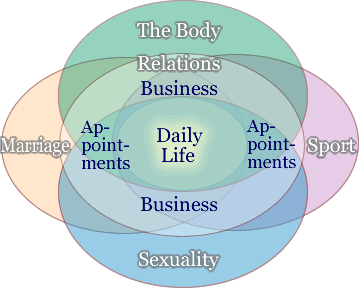
For the spiritual department, however, we have a different emphasis. Instead of being structurally involved in a scientific sense, one becomes involved on principle. The question that arises is how the discipline of alternative time consciousness would look in practice. Instead of tables showing the structure of time, there are behavioral directions, discussions of principles, value estimations, and graphical presentations. We have an encyclopedically arranged self-help section that is essentially a separate book named "The Other Rules," which categorizes the different aspects of transcendence for a happier self into eight sections concerning daily life, business, dates, relationships, marriage, sports, matters of the body, and sexuality. These eight categories correspond to the eight angas of yoga. Next are the chapters on reincarnation and the fear of time, the essence of spirituality, the relationship between spirituality and sexuality, the dialectical nature of filognosy in spiritual terms, and the factual structure of the different divisions of concepts.
     In this section, we conclude that the spiritual perspective represents the integrity of gnosis, the true unity of Christianity, which evolved into a syncretic filognosy. Yoga, in all its aspects, is the discipline that offers us the only absolute and real thing: the moment of the here and now. Spirituality teaches us that, as the Chinese say, we share the moment but differ in place and time. The moment is absolutely the same, but the time is absolutely different. The moment is real when the time is different. Regarding the absolute, it is important to remember that there are two types of absolutes: the absolute difference of time and the absolute sameness of the moment.
Let Patańjali be happy with the moment, and let Einstein be happy with the time.


Voetnoot

* The four identities to the modes and the transcendence are known as the the Game of Order the human being plays in his identity of functioning with a certain experience in respect of the four classes, four statuses, the three modes and the eight levels of transcendence.

Pictures:

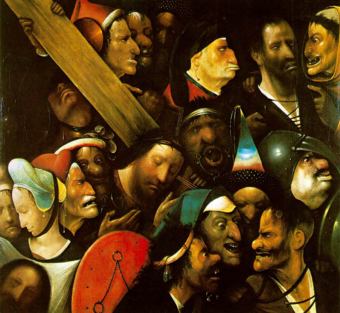
The painting with Jesus is of Hieronymus Bosch. It is called Christ carries the cross and dates from 1485-1490, oil on panel 76.7 x 83.5 cm. and can be found in the Musée des Beaux-Arts in Gent, Belgium.

The etching with the birds is of M.C. Escher. It is a woodcut printed from four blocks, and is titled Sun and Moon. It dates from 1945 and measures 25.1 x 27 cm.

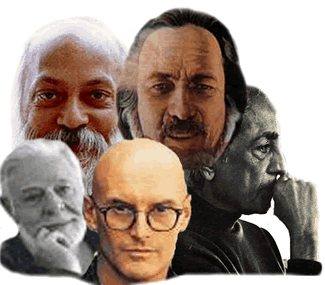
The portraits of the transcendentalists are, upper-left to right of: Osho, Jan Foudraine, middle: Alan watts and Ken Wilber and at the right in profile J. Krishnamurti.

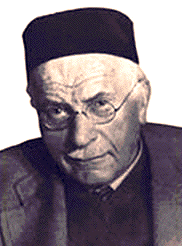
The man carrying the fez is the analytical psychologist Carl Gustaf Jung.

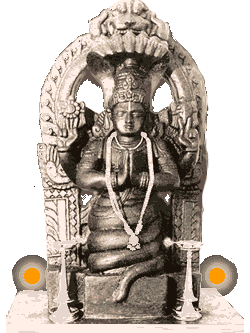
The statue underneath represents Patańjali with the body of a snake because he is considered to be an incarnation of Adi S'esha or Sankarshana.

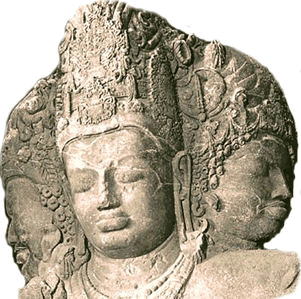
The statue with the three heads is a so-called trimūrti from India, showing the three gods S'iva, Brahmā en Vishnu as one.

The picture with the Ohm sign in it is a sundial pictured as a representation of the will of God.

The picture with the colored fields is a graphical representation of the interwoven levels of transcendence that are discussed in the Other Rules according the subjects in the fields indicated.



The site linear as a perfection of the causal illusion:


_     


The Other Rules (free E-book)| Filognosy & Terms| Filognostic Guide|Reincarnation & Time|The Essence|Time for Sex | Terms