Pamphlet
for a New Energy Policy
"All truth
passes through three stages.
First, it is ridiculed.
Second, it is violently opposed.
Third, it is accepted as being
self-evident."
Arthur
Schopenhauer
(1788-1860)
1) The
necessity
of a new energy policy
The modern energy
question is a profound one. The
survival of mankind is at stake. As
we clearly see at the beginning of
the 21th century, we cannot continue
using fossil fuels. We must
transition to sustainable energy
sources, partly because 1) the
energy resources of oil, gas and
other fossil fuels are depleting,
but also 2) because the use of
non-sustainable energy sources,
leading to excessive CO2 emissions,
poses an imminent threat for the
biological balance and the
habitability of this planet.
Additionally, we face geopolitical
governance and related military
power conflicts in connection with
the pursuit of a
mew world order in response to
the numerous crises of climate
change .
With the
second factor of the environment,
indicating the limits of what Mother
Earth can bear from us humans, we
seem to be approaching a tipping
point. The climate warming around
mid-2007 is a well-established fact,
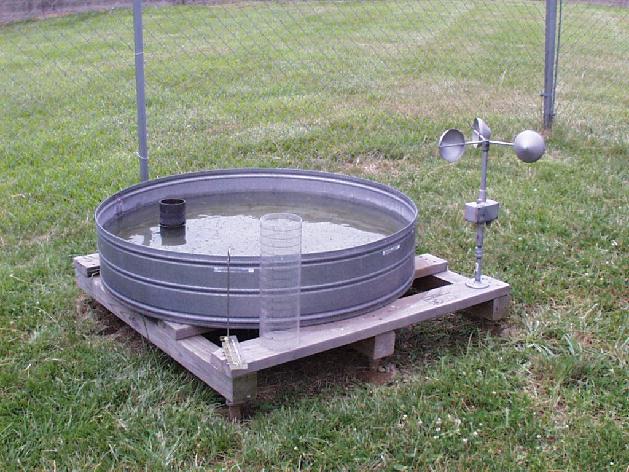
but even in the 50 years prior to
that, the intensity of sunlight, for
example, measured by the so-called
pan-evaporation, a sort of
meteorological evaporation index,
decreased by about 15%, presumably
due to soot particles and other
chemical compounds in the higher
atmospheric layers around the Earth.
Causes and consequences are under
discussion. An increase in
atmospheric particles results in a
'dimming' effect, but due to recent
climate measures, this dimming is
decreasing, and pan-evaporation is
increasing again (see, for example,
Wikipedia on global
dimming
and pan-evaporatie).
The CO2 level on Earth shows natural
fluctuations; historical data
obtained from tree rings and ice
cores are subject to multiple
interpretations. Feedback mechanisms
between the atmosphere, ice masses,
oceans, and the biosphere, which can
cause rapid escalations or mitigate
climate effects, also make a precise
assessment of the influence of CO2
levels uncertain. Climate effects
are difficult to predict due to
tipping points that can lead to
unexpected developments, such as a
faster rising sea level or,
conversely, a not yet alarming but
certainly slightly decreasing
oxygen content in the atmosphere due
to more combustion, fewer forests,
and reduced ocean vitality due to
CO2-induced acidification.
Conversely again, extreme weather,
such as sudden cooling, can be
temporarily caused by events like
volcanic eruptions. Climate effects
in terms of drought and
precipitation vary regionally, so a
changing climate balance does not
immediately provide clarity about
its causes and consequences, about
the seriousness of the situation, or
whether it is an acceptable natural
variation temporarily responding to
the influence of human culture,
which is also subject to
(self)limitation. There is much
confusion, even in science. There is
also a psychological effect of no
longer being aware of the problem
due to habituation and
rationalization, much like a frog
not jumping out of a pot of
gradually boiling water.
Nevertheless, scientific progress in
the development of climate models,
improved risk assessments, and
enhancements in technological and
ecopolitical adaptation strategies
provide us with greater resilience
and a better understanding of the
climate problem. Despite
uncertainties about the causes and
consequences of CO2 levels, climate
change, and geopolitical issues, as
well as uncertainties about what we
could do about them so far, an
overwhelming majority of experts
agree that human activities
significantly contribute to higher
levels of CO2 and other greenhouse
gases, and thus, also to associated
climate change. Heat in the
atmosphere is trapped, indeed, like
in a greenhouse. Hence, a proactive
approach, a strategy preventing
worse outcomes, is necessary to
counter and reverse climate changes.
Limits have been set on our growth
and consumptive desires; we need to
plant more trees to absorb CO2 and
develop more sustainable energy
sources to prevent global warming.
It is
clear that many factors must be
considered if we want to transition
to a different way of generating
energy while preserving the natural
and cultural order on our planet. It
can be overwhelming to realize the
complexity of the climate problem
and the energy issue. There are
effects such as desertification, the
global food problem, water
management, the dying off of marine
and terrestrial life, the melting of
polar ice caps, and the permafrost
in Siberia, releasing vast amounts
of methane gas that further
contribute to the greenhouse effect.
Every aspect of the
crisis facing our world has its own
implications for the environment and
culture and requires its own
measures. A so-called
emission-neutral, sustainable policy
might theoretically create a
political balance between warming
due to the greenhouse effect and
cooling as a result of climate
measures taken. However, simply
pausing and relying solely on
pollution prevention and the use of
biofuels and other
non-emission-free, less sustainable
techniques could lead to
far-reaching negative consequences.
The problem of clean energy
technology is not solved with
compensation measures alone.
A further decline in
the overall habitability of the
planet and in energy and food
policies, as well as further
disruption of the natural balance of
the associated climate and human,
animal, and plant well-being, will
inevitably lead to significant
cultural and political problems when
pursuing policies based on political
feasibility but acting fundamentally
from ecological ignorance. We cannot
be content with this. With a
one-sided, purely economically
understood policy of 'cleaning the
atmosphere' and 'creating a new
balance', the planet's temperature
could rise by several degrees in
just a few decades, melt the
pole caps and cause catastrophic
consequences for all low-lying
coastal areas worldwide.
We must not delude
ourselves into thinking that we can
solve this with solar panels and
wind turbines. Climate science warns
against such policy simplifications.
A broad-spectrum approach is needed,
including scientifically. We need a
constant energy source with a much
higher energy density than solar
photons and an unstable atmosphere.
Thus, in the search for alternative
energy sources, there has been a
renewed interest in nuclear energy.
Nuclear power plants, based on atom
splitting, have optimal energy
density with their nuclear fuel;
however, they are not inherently
clean energy sources due to the
atomic fissile materials they
require. Uranium and similar
radioactive metals not only pose an
environmental problem with the
radioactive waste they leave behind
but also, as widely known, come with
great danger. If something goes
wrong, we face nearly irreparable
environmental damage. The disasters
in Chernobyl, Ukraine, and
Fukushima, Japan, serve as examples
of this.
 So also
could next to that, in the search
for alternative energy resources, a
renewed interest for nuclear energy
be observed, which essentially
constitutes no sustainable source of
energy because of the fossil nuclear
materials that are needed. And there
is also a serious objection, as is
generally known, against the nuclear
waste and the danger of this method.
An alternative technology for
nuclear energy production would be
the technology of nuclear
fusion. As yet is the most
favorable technique for controlling
the immense heat needed for the
nuclear fusion the floating and
spinning of the fusion plasma in a
strong magnetic field in a so-called
tokamak. This technology
though delivers no degree of
overunity in 2007: one never
achieves more energy out of the
process than one has put in. The
entire project of nuclear fusion
without a fusion-efficient form of
fuel just might turn out to be a
terribly expensive illusion. Helium-3, a helium atom
missing a neutron, would be a
candidate to have a more efficient
output with less input of energy in
the fusion process. The element
itself is radioactive neutral so
that less problematic radiation is
released with the nuclear fusion. It
offers a cleaner fusion process, be
it that one also with the He-3
cannot reach an entirely
radiation-free production of energy.
The element which on itself is
stable in a crystalline form and
with its special properties
extensively is researched by the
physicist E.R.
Dobbs, is rare on earth
but abundantly available on the moon
as a form of precipitated solar
wind. Even though He-3 can be
artificially created from
Tritium-decay and also is known as a
byproduct of nuclear weapons, must
it, to supply the entire world
efficiently with energy, be mined on
the moon. An enthused adherent of
the method may, via a handy website
selling options on lunar territory,
in advance reserve
a place there. One supposedly
could find there enough energy in
the form of Helium-3 for the entire
earth for many centuries. But such a
policy of winning energy will with
the moon bases and space-shuttles
required, be such an economically,
culturally and scientifically
extensive operation that, not even
considering that the supply of He-3
at the moon is also finite - it is a
very luxurious type of fossil fuel
thus -, also this option must be
discarded as being too uncertain in
an economic sense, too dangerous in
a geopolitical sense and as
technologically too laborious.
Nuclear fusion in other ways, like
the so-called aneutronic fusion process which
is not in need of any He-3, has
itself as yet not unequivocally
proven as being efficient, or even
as a feasible practice. Nuclear
fusion seems to be a beautiful
scientific challenge, but whether it
is ever going to be a realistic
alternative source of energy free
from ecological, political and
economic objections, is thus most
uncertain, despite of the enormous
scientific efforts and financial
expenses in the previous decennia. So also
could next to that, in the search
for alternative energy resources, a
renewed interest for nuclear energy
be observed, which essentially
constitutes no sustainable source of
energy because of the fossil nuclear
materials that are needed. And there
is also a serious objection, as is
generally known, against the nuclear
waste and the danger of this method.
An alternative technology for
nuclear energy production would be
the technology of nuclear
fusion. As yet is the most
favorable technique for controlling
the immense heat needed for the
nuclear fusion the floating and
spinning of the fusion plasma in a
strong magnetic field in a so-called
tokamak. This technology
though delivers no degree of
overunity in 2007: one never
achieves more energy out of the
process than one has put in. The
entire project of nuclear fusion
without a fusion-efficient form of
fuel just might turn out to be a
terribly expensive illusion. Helium-3, a helium atom
missing a neutron, would be a
candidate to have a more efficient
output with less input of energy in
the fusion process. The element
itself is radioactive neutral so
that less problematic radiation is
released with the nuclear fusion. It
offers a cleaner fusion process, be
it that one also with the He-3
cannot reach an entirely
radiation-free production of energy.
The element which on itself is
stable in a crystalline form and
with its special properties
extensively is researched by the
physicist E.R.
Dobbs, is rare on earth
but abundantly available on the moon
as a form of precipitated solar
wind. Even though He-3 can be
artificially created from
Tritium-decay and also is known as a
byproduct of nuclear weapons, must
it, to supply the entire world
efficiently with energy, be mined on
the moon. An enthused adherent of
the method may, via a handy website
selling options on lunar territory,
in advance reserve
a place there. One supposedly
could find there enough energy in
the form of Helium-3 for the entire
earth for many centuries. But such a
policy of winning energy will with
the moon bases and space-shuttles
required, be such an economically,
culturally and scientifically
extensive operation that, not even
considering that the supply of He-3
at the moon is also finite - it is a
very luxurious type of fossil fuel
thus -, also this option must be
discarded as being too uncertain in
an economic sense, too dangerous in
a geopolitical sense and as
technologically too laborious.
Nuclear fusion in other ways, like
the so-called aneutronic fusion process which
is not in need of any He-3, has
itself as yet not unequivocally
proven as being efficient, or even
as a feasible practice. Nuclear
fusion seems to be a beautiful
scientific challenge, but whether it
is ever going to be a realistic
alternative source of energy free
from ecological, political and
economic objections, is thus most
uncertain, despite of the enormous
scientific efforts and financial
expenses in the previous decennia.
More in line with a
mechanically easily manageable and
economically efficient approach in
this field is the so-called 'cold fusion', also known as
low energy nuclear reaction
(LENR), first developed in
1989 by the chemists B.
Stanley Pons and Martin
Fleischmann from the University of
Utah in de U.S.A. They
demonstrated how, with just two
electrodes (an anode of platinum,
and a cathode of palladium) in
heavy water (deuterium oxide) with
low current can, additional heat
of heat excess can be generated,
only explainable by a nuclear
process. Although the process,
which produces no harmful
radiation, was not immediately
well understood or controlled, the
fact that this effect could be
generated for one up to two days
and leven longer using only a
small container of (heavy) water,
contradicted existing scientific
models. Cold fusion was therefore
initially met with skepticism.
However, in 1990, Michael McKubre,
the director of the Energy
Research Center of Stanford
Research International, along with
the researchers Richard A. Oriani
of the University of 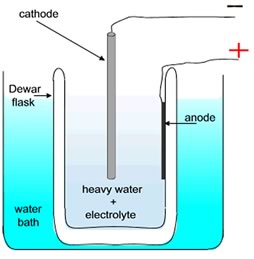 Minnesota, Robert
A. Huggins of Stanford University
and Y. Arata of the University of
Osaka in Japan, joined in supporing
their findings. In 50% of the
investigations they found the
mentioned results of additional
heat and other related phenomena.
In 1993 a group of U.S. Navy
researchers of the China Lake
Naval Weapons Center in
California, led by the
chemist Melvin Miles, conducted an
investigation into the bubbles
developing in the device. that
were appearing in the device. They
concluded from mass spectrometric
measurements that Helium-4 was
present.
Despite the fact that the
quantities found did not match
existing theories, they provided
evidence that a form of
room-temperature atomic fusion had
indeed occurred, explaining the
heat production. Minnesota, Robert
A. Huggins of Stanford University
and Y. Arata of the University of
Osaka in Japan, joined in supporing
their findings. In 50% of the
investigations they found the
mentioned results of additional
heat and other related phenomena.
In 1993 a group of U.S. Navy
researchers of the China Lake
Naval Weapons Center in
California, led by the
chemist Melvin Miles, conducted an
investigation into the bubbles
developing in the device. that
were appearing in the device. They
concluded from mass spectrometric
measurements that Helium-4 was
present.
Despite the fact that the
quantities found did not match
existing theories, they provided
evidence that a form of
room-temperature atomic fusion had
indeed occurred, explaining the
heat production.
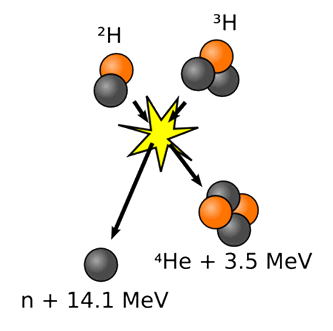
In fusion, two heavy 2H or
deuterium atoms merge into
Helium-4 with the release of
energy. In hot fusion, millions of
degrees Celsius are required,
using additional, hard-to-obtain
tritium, another isotope of
hydrogen. But how can such a
process occur at room temperature?
Even though this is clearly a case
of protoscience, a science
still in its infancy, it is often
labeled as pseudoscience,
or a form of self-deception or
delusion based on flawed methods,
with the standard mutual
skepticism regarding each other's
research designs. However, it
wasn't the methods that were
flawed, given all the sincere
scientific efforts; it was the
prevailing paradigm that was
flawed.
To understand why
cold fusion is often wrongly
labeled as pseudoscience, or why
such an important research
phenomenon is misclassified, we
need psychology, philosophy, and
other scientific disciplines. With
the mysterious research results,
one ends up outside the boundaries
of the prevailing classical model
of physics. Scientists are not
quick to abandon the familiar
territory of natural science with
paradoxical results pointing to
unknown processes. Such a
convention-bound group of
scientists cannot easily master
all the additional sciences that
play a role in such a significant
shift in scientific thinking."
Despite of the
great number of published
investigations that found an
anomalous heat production,
concluded the United States
Department of Energy (DOE) that
in 1989 formed a research panel to investigate the
case, that no sufficient proof had
been delivered for the reality of
this cold fusion process and that
for that reason no research funds
needed to be provided for further
development. Also a second panel
in 2004 arrived at a likewise
conclusion, be it that the
argument against had been watered
down. The report of 2004 in fact
constituted a turning point
because from its conclusions the
more reputed scientists and more
important commercial magazines
(Time, Scientific American) now
dared to pay some more attention
to the subject. But nevertheless
one also in 2007 in the U.S.A. was
investing many billions of
research grants for new energy
technologies rather in the far
more doubtful hot fusion process,
which thus never delivered more
energy - and thus certainly also
not more money - than was put in.
In the U.S.A. cold fusion remained
a taboo, while one in Asia e.g. is
more inclined to reward patents in
this field. Also with science in
formal politics a narrow-minded
village mentality can be prominent
that, based on ulterior motives
and with surpassing reason,
rejects everything which the
establishment of the confided ego
of exercising authority, the usual
teachings and the associated wages
earned that way, would endanger.
For if there would be a formal
recognition, the world would be
turned upside down, because we in
that case would have a revolution:
all societal and economic
relations would change and also
would all textbooks have to be
rewritten and the educational
system be reformed. And who would
stand and sign for that? Progress
ultimately is an egoless process
in which each and everyone plays
his part. Now at the beginning of
the 21st century there are with
that process already commercial
signs observable, for also money
runs where it cannot go: Energy
Technologies in Israel, D2Fusion in California, JET
Thermal Products in Massachuchets,
Mitsubishi motors
and
The Mastrrr
Company in Texas are the
corporations that 2007 are engaged
in harnessing the process of cold
fusion for the sake of different
purposes like the purification of
water, mechanical propulsion, and
the supply of energy. What thereto
for the acceptance of the greater
public still is needed is the
entire account of the paradigm
associated with the cultural
change involved. In this
pamphlet the complete of the
paradigmatic question with
everything belonging thereto will
be discussed at length. In this
study, based on the latest
experimental and theoretical
findings in this field of free
energy as also on the rest of the
testimonies of witnesses
associated with the question of
energy, will be attempted to
contribute to the further
development of this new paradigm
for the 21st century, now emerging
in postmodern times. We are on the
way of a renewed scientific
thought model, with which we may
speak of a new World Order. It turns out,
as we now see, that this is an
order based not merely on the
promotion - whether military
or otherwise - of “democracy,”
with the blurring of borders
in a global climate where a
form of free enterprise is
allowed to prevail that does
not necessarily serve the
social and biological
well-being of the planet
itself.
The cards are shuffled differently
thus. A better ecological policy
is necessary, we after all have to
survive ourselves too with each
his individual freedom of
defending his material interests.
It is all about
a broader and more responsible
concept of world order, a concept
which also reaches beyond the
three pillars of internet
communication, hydrogen storage
and the two-way distribution of
energy which, as being the essence
of a third industrial revolution,
lately 2007 was suggested by the
american economist Jeremy Rifkin. His still most
expensive solution of 850 billion
for an intelligent energy network
to feed back self produced energy
into the grid is a new energy
policy all right but is still
based on the old paradigm of
science. In the new model emerging
now under the influence of cold
fusion, and the other free energy
technologies we will discus
later, everybody at every
moment of the day draws as much
'new energy' as he needs with the
new technology, and that can
privately be done as good as by
means of a central power plant, we
after all are talking aboutfrom a
truly free energy market. Storage
is this new perspective not
needed anymore, and that is an
extra advantage for everyone on
the planet. What Rifkin is
defending so nicely up to date is
seen in this light again already
outdated. The progress at this
front is very fast. The hydrogen
obsession of storing energy is not
applicable any longer with the
direct, according the need won
energy of e.g. cars that run on
cold fusion generators (see also:
Basics; peswiki-article, Cold fusion 18
years and heating up; Eugene Mallove; News; ISCMNS (society); Naudin project; FAQ; Conferenties).
Culturally and
psychically we have to fear for
conflicts if we do not have a clear
notion of the inevitable question of
another policy of winning energy.
Winning energy we are dealing with
nature, nature that gave us our
form, nature that educated us, that
conditioned our genes, that
conditioned all of our behavior, and
our culture somehow will have to
reflect that properly. Pragmatically
thinking in favor of a quick result
and economic success this is easily
forgotten. Nature operates upon our
genes and we switch with those genes
responding to her with adapting
ourselves to her dynamics. Our genes
constitute the material with which
we people, also in our cultural
activities, find ourselves in an
evolution which cannot be stopped at
will or be obstructed. There is a
cultural as also a natural authority
ruling our lives. Ultimately it is
about the question, as we very well
know politically, who the boss would
be, who is leading us, what in our
decision making would come first. It
must be clear in our minds eye
whether, and to what degree, we are
formed by pragmatical and economical
dictates, which are also known as an
endless struggle for power over
whatever political grip or whatever
advantage would have the - temporary
- right of way. Or differently we
admit, like it was proclaimed with
the French Revolution in the
beginning, that we have our footing
in nature and therein find our
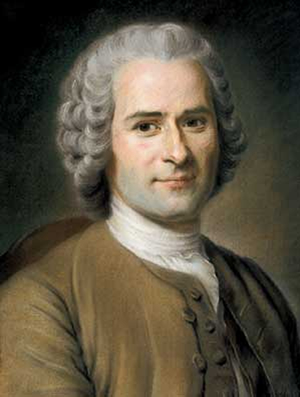
primary order and harmony [see
especially the works of the
philosopher J.J.
Rousseau, (1712-1778)]. When we
psychically want to get rid of the
cultural uncertainty and personal
misery which is the consequence of a
conflict between the material
interests of our culture and those
of nature, deeds must be done, deeds
that have consequences for the
policies of winning energy and
caring for the environment. Caught
between the two fires of the
material, idle, short-sighted
profit-mind and the mind in favor of
the spirit of the preservation of
nature which demands more conscience
and effort, we may speak of a
conflict situation in which we
psychically are burdened with a
tormenting uncertainty about the
following question: wherein exactly
can we find our true certainty and
direction, our control and our
confidence? In that area of tension
we keep on searching for harmony and
balance without, in our from
attachments born indecision, us ever
finding a collective solution or
enduring form of world peace and
collective righteousness of living.
A definitive choice
has to be made, the indecision has
to be given up before we are forced
to decisions by the occurrence of
cultural or natural disasters. With
putting an end to this
nature-culture conflict, the way it
for instance lately is happening
with the more environmental friendly
and sustainable Cradle
to Craddle philosophy of William McDonough
and Michael Braungart in the field
of corporate interests, the
democracy then may be more a
reflection of the order we find in
nature in stead of being a
reflection of an everlasting,
power-uncertain, political struggle
which is in fact a destructive neurosis
of culture. The struggle based on
the inability to act directly from
nature and to agree about it amongst
ourselves, must end. That era we
have to close. Also in the sense of
our scientific thinking. The
question first of all is thus: in
what ways can we relate to nature
when it is about sustainable energy
policies? Next the question rises
what the scientific consequences
would be and how we exactly as
normal people in our educational
systems, and in what we personally
teach our children, have to consider
with the methods and technologies
found. How would such a world order
look like which is based upon the
natural order of the wheelwork of
nature, upon the wheelwork of the
clock formed by the sun, the moon
and the stars and not so much any
longer is based on a division in
territories and other concepts of
false oneness, from the interest of
which we have to fight each other's
ego's? Is such a thing possible?
(see also the article Sun,
Moon and the new World Order)


-
-
|